


Guide Overview
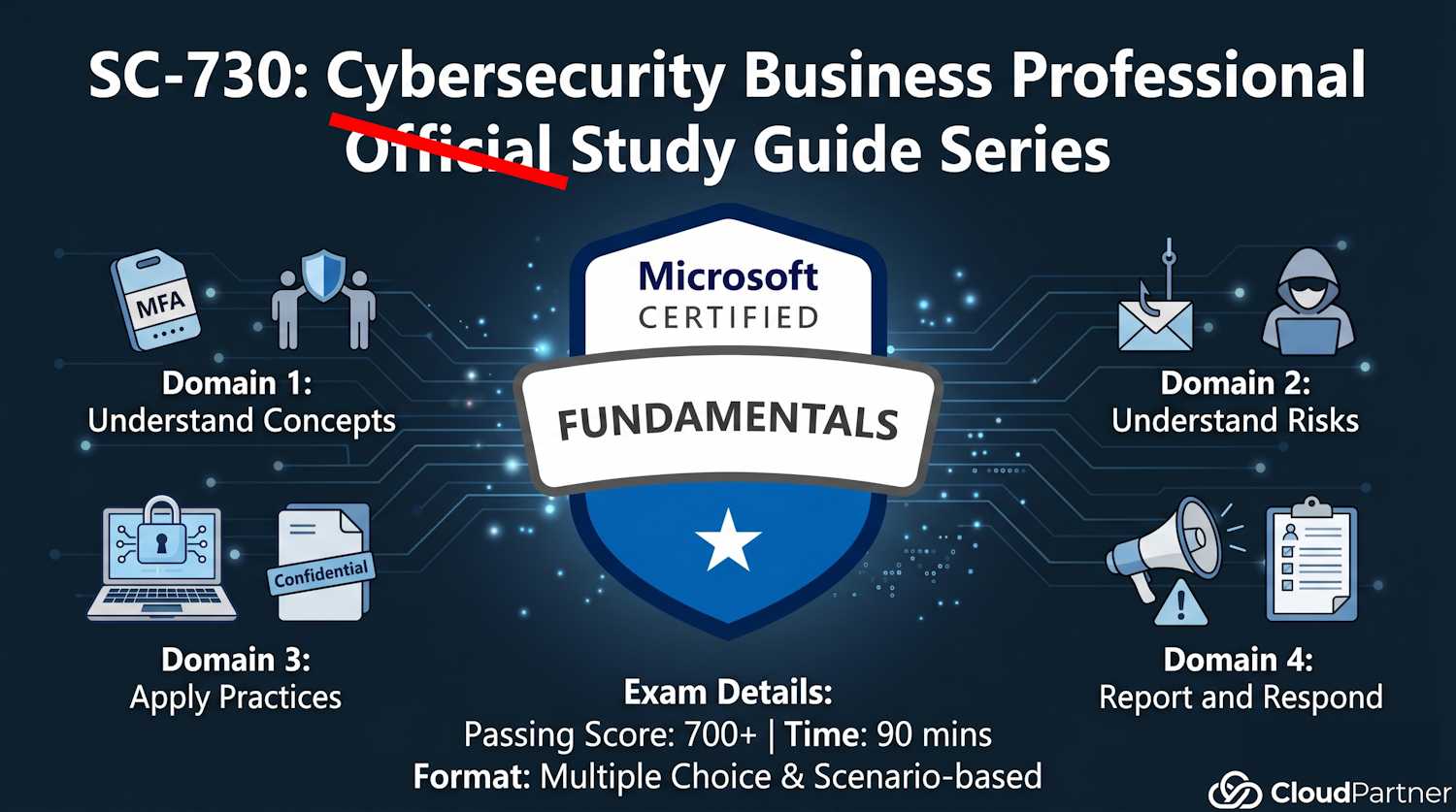
The SC-730: Cybersecurity Business Professional exam validates foundational cybersecurity knowledge for non-technical business professionals. This comprehensive study guide breaks down the exam into focused, digestible sections to help you master each domain.
Passing Score: 700+ out of 1000 | Time: 90 minutes | Format: Multiple choice and scenarios
The Four Exam Domains
The SC-730 exam measures your ability across four interconnected skill areas. Each domain is weighted differently on the exam:
Domain 1: Understand Cybersecurity Concepts
Foundation knowledge of cybersecurity roles, responsibilities, basic policies, MFA, password management, and key security definitions.
You'll learn:
- Shared responsibility model for security
- Why MFA is critical and how it works
- How password managers protect your credentials
- Key definitions: vulnerability, threat, risk, exploit, encryption
- What deepfakes are and why they matter
Domain 2: Understand Cybersecurity Risks and Threats
Recognition of common threats, social engineering tactics, malware indicators, insider threats, and suspicious communications.
You'll learn:
- Why public Wi-Fi is dangerous and how to protect yourself
- Phishing, pretexting, and baiting tactics
- How to spot malware and insider threat indicators
- Email verification and detecting suspicious attachments
- Access control best practices
Domain 3: Apply Basic Security Practices
Practical security implementation for devices, accounts, data handling, sensitive data protection, and backup strategies.
You'll learn:
- How to secure remote and mobile devices
- Data classification and sensitivity labeling
- The complete data lifecycle: collect, use, transfer, store, retain, destroy
- Why backups matter and how to recover from data loss
- Rights management and encryption basics
Domain 4: Report and Respond to Security Incidents
Knowledge of when and how to report incidents, what information to include, and proper response procedures for breaches.
You'll learn:
- What incidents require immediate reporting
- How to prepare a comprehensive incident report
- Where and how to report (IT, security, management)
- Steps to take during a data breach
- When to escalate to senior leadership
Understanding the Exam Format
SC-730 uses multiple-choice and scenario-based questions. The exam tests practical knowledge, not memorization:
| Question Type | What to Expect | Example |
|---|---|---|
| Multiple Choice (Best Answer) | Single correct answer from 4 options | "Which is the primary benefit of MFA?" Answer: "Blocks 99.9% of account compromise attempts" |
| Scenario-Based | Real-world situation; choose appropriate action | "You receive suspicious email. What do you do FIRST?" Answer: "Report to security team; don't click link" |
| Identify Best Practice | Select correct procedure or policy application | "How should you handle confidential data transfer?" Answer: "Use encrypted channel; verify recipient legitimacy" |
Recommended Study Path
For First-Time Learners: Read in order (Part 1 → Part 2a/2b → Part 3a/3b → Part 4). Each part builds on previous knowledge.
For Refresher Study: Jump to the part you need. Each is self-contained with full context.
For Exam Prep: Read all parts, then review scenario sections. Practice thinking: "What would I do in this situation?"
Quick Study Statistics
| Metric | Coverage |
|---|---|
| Total Study Pages | 6 focused pages (1 index + 5 domain parts) |
| Domains Covered | 4 main skill areas; 100% of exam objectives |
| Real-World Scenarios | 30+ practical examples from actual business settings |
| Estimated Reading Time | 6–8 hours total (distributed across pages) |
| Content Source | Microsoft Learn + Official SC-730 Study Guide + Industry Best Practices |
Key Insights Before You Start
SC-730 is about practical awareness, not technical expertise. You don't need to understand how firewalls work—you need to recognize phishing and report it.
The exam rewards decision-making in realistic scenarios. Most questions follow this pattern: "Here's a situation. What's the right action?" Think about real business contexts, not textbook definitions.
Threat recognition is more important than technical implementation. Can you spot a compromised email? Do you know when to report to IT? Those skills matter most.
Official Microsoft Resources
Before you start, bookmark these. They're the authoritative source for what's actually on the exam — and where you register to take it.
| Resource | What it is | Link |
|---|---|---|
| SC-730 Exam Page | Official exam overview, objectives, scoring, and registration | learn.microsoft.com/credentials/certifications/exams/sc-730 |
| Microsoft Cybersecurity Business Professional Certification | The credential you earn by passing SC-730 — what it means and how employers verify it | learn.microsoft.com/credentials/certifications/cybersecurity-business-professional |
| Exam Skills Outline (PDF) | The official skills measured document — the definitive list of what Microsoft tests | Download from the SC-730 exam page (under "Skills measured") |
| Schedule the Exam | Book your test via Pearson VUE (online proctored or test centre) | Schedule via Microsoft Exam Registration |
Cross-check with the official skills outline. Microsoft updates exam objectives periodically. Before your exam, download the latest "Skills measured" PDF from the SC-730 exam page and confirm this study guide still aligns with the current version.
Getting Started
Choose your study path:
- Start with Part 1: Cybersecurity Concepts
- Move to Part 2: Common Risks & Social Engineering + Threat Detection
- Continue to Part 3: Device & Data Security + Data Handling
- Finish with Part 4: Incident Response