


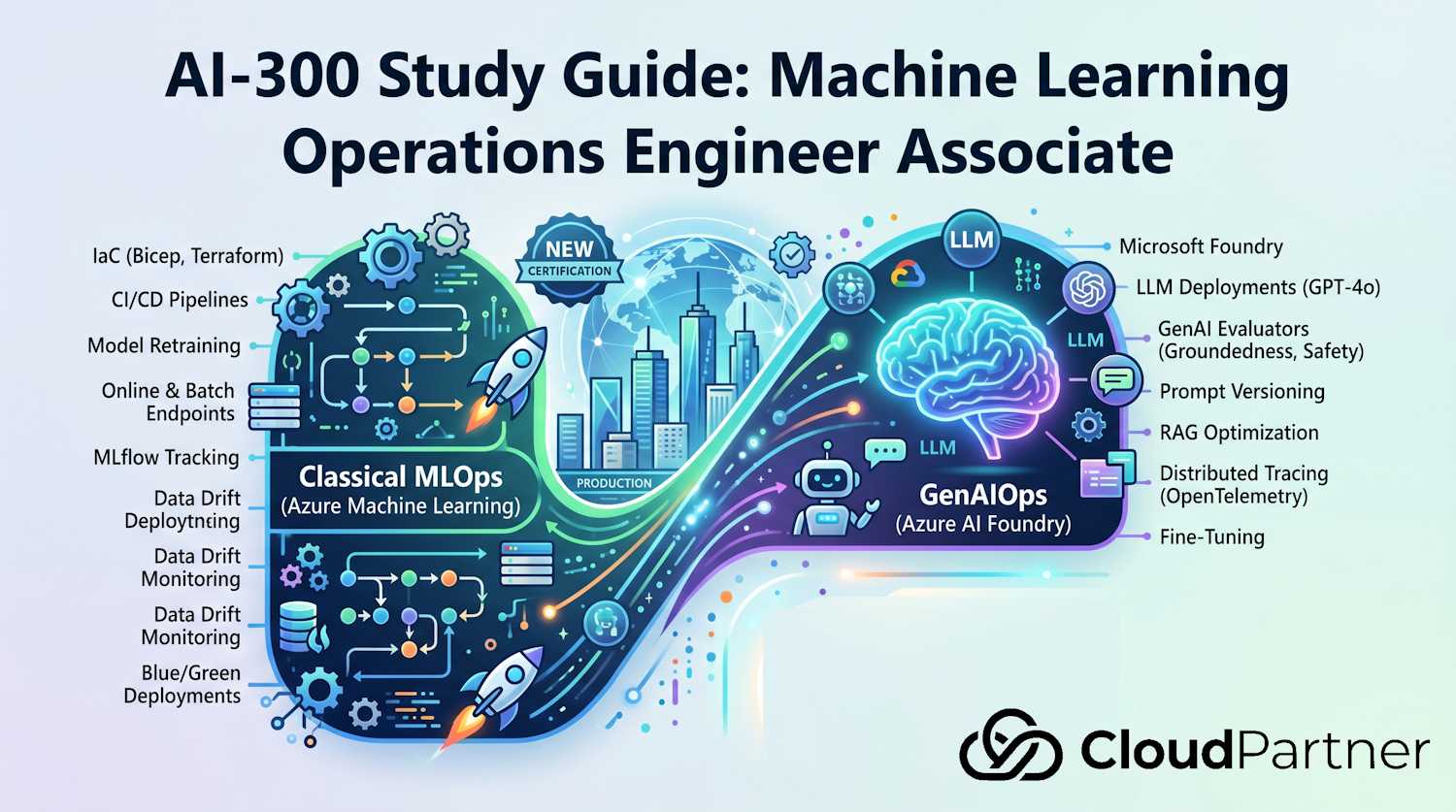
New certification: AI-300 replaces DP-100 and broadens the scope well beyond data science. It covers both classical MLOps (Azure Machine Learning) and GenAIOps (Microsoft Foundry, generative AI evaluation, fine-tuning). Beta exam opened April 2026, goes live May 2026.
Overview
The AI-300 exam is aimed at engineers responsible for taking AI and ML systems to production and keeping them running reliably. This includes infrastructure-as-code for ML workspaces, CI/CD pipelines for model retraining, deploying and managing large language models on Foundry, and implementing observability for both classical models and generative AI applications.
Exam Details
| Detail | Information |
|---|---|
| Exam code | AI-300 |
| Certification | Machine Learning Operations Engineer Associate |
| Level | Associate |
| Passing score | 700 / 1000 |
| Duration | 120 minutes |
| Cost | $165 USD (varies by region) |
| Beta availability | April 2026 |
| Exam goes live | May 2026 |
| Predecessor | DP-100 (retires June 1, 2026) |
Exam Objectives
The AI-300 exam is organized into five skill domains. Together, they cover the full lifecycle of machine learning and generative AI operations — from infrastructure and pipeline design through model lifecycle management, deployment, quality assurance, and performance optimization.
Design and Implement MLOps Infrastructure (15–20%)
Create and manage machine learning environments at scale. Includes:
- Building Azure Machine Learning workspaces with Bicep or Terraform IaC
- Configuring datastores, compute targets, and data assets for reproducible training
- Implementing secure identity with managed identities and Azure RBAC role assignments
- Enforcing network isolation with private endpoints, service endpoints, and firewall rules
- Automating workspace provisioning and project workflows with GitHub Actions and Git integration
- Setting up registries for sharing trained models, environments, and reusable components across workspaces
Implement Machine Learning Model Lifecycle and Operations (25–30%)
Manage the full model lifecycle from training through production. Covers:
- Building training pipelines with components, jobs, hyperparameter tuning, and distributed training
- Configuring MLflow experiment tracking, model registry versioning, and lineage tracking
- Deploying models to managed online endpoints for real-time inference and batch endpoints for asynchronous scoring
- Implementing progressive rollout strategies: blue/green, canary, A/B testing, and traffic management
- Monitoring model performance, data drift, and operational health using responsible AI tooling
- Configuring automated alerts, retraining triggers, and continuous model refresh workflows
- Managing endpoint scaling, quotas, and cost optimization across deployments
Design and Implement GenAIOps Infrastructure (20–25%)
Build production-grade generative AI systems in Microsoft Foundry. Includes:
- Provisioning Foundry Hubs and Projects using Bicep, Terraform, or Azure CLI
- Securing Foundry resources with managed identities, Azure RBAC, private endpoints, and private networking
- Deploying foundation models (GPT-4o, o3, Phi, Llama, Mistral) using serverless API endpoints, managed compute, and Provisioned Throughput Units (PTU)
- Implementing model versioning, production deployment strategies, quota planning, and rate-limit management
- Designing and versioning prompts in Git repositories with variant tracking and A/B testing
- Configuring API Management (APIM) gateways for semantic caching, token limits, and policy enforcement
Implement Generative AI Quality Assurance and Observability (10–15%)
Ensure GenAI applications meet quality and safety standards. Covers:
- Creating comprehensive test datasets and evaluation mappings for models, applications, and agents
- Configuring evaluation runs with built-in evaluators: groundedness, relevance, coherence, fluency
- Implementing custom evaluators using Python and LLM-as-judge patterns
- Building quality gates into development and release CI/CD pipelines for automated validation
- Setting up continuous monitoring for generative AI applications and agents in production
- Tracking latency, throughput, token consumption, resource usage, and total cost of ownership
- Configuring detailed logging, OpenTelemetry tracing, and debugging for production troubleshooting
Optimize Generative AI Systems and Model Performance (10–15%)
Improve RAG pipeline accuracy and inference efficiency. Includes:
- Optimizing Retrieval Augmented Generation with chunk sizes, similarity thresholds, reranking, and query expansion
- Selecting, evaluating, and fine-tuning embedding models for domain-specific retrieval quality
- Implementing hybrid search combining semantic, vector, and keyword retrieval techniques
- Designing and executing advanced fine-tuning workflows using Supervised Fine-Tuning (SFT), Direct Preference Optimization (DPO), and Reinforcement Learning from Human Feedback (RLHF)
- Creating and managing synthetic training data for fine-tuning and domain customization
- Moving fine-tuned models from development to production with performance monitoring
- Optimizing inference cost and latency through batching, semantic caching, model-size selection, and deployment-tier optimization
Skills Measured
Design and Implement MLOps Infrastructure (15–20%)
- Create and manage Azure Machine Learning workspaces, datastores, and compute targets
- Create and manage data assets, environments, and reusable components
- Share assets across workspaces by using Azure Machine Learning registries
- Configure identity and access management with managed identities and Azure RBAC
- Deploy Azure Machine Learning workspaces and resources by using Bicep and Azure CLI
- Automate provisioning and project workflows with GitHub Actions and Git integration
- Restrict network access to Machine Learning workspaces with private networking controls
Implement Machine Learning Model Lifecycle and Operations (25–30%)
- Configure MLflow experiment tracking and compare model performance across jobs
- Use notebooks, automated machine learning, training scripts, hyperparameter tuning, and distributed training
- Build training pipelines with Azure Machine Learning jobs, components, and reusable assets
- Register, version, package, and deploy models by using MLflow and Azure Machine Learning registries
- Deploy models to managed online endpoints for real-time inference and batch endpoints for asynchronous scoring
- Implement progressive rollout, blue/green, canary, rollback, and endpoint traffic-management strategies
- Evaluate model quality with Responsible AI tooling and monitor deployed models for drift, performance degradation, and operational health
- Configure alerts, retraining triggers, and automated model refresh workflows
Design and Implement GenAIOps Infrastructure (20–25%)
- Create and manage Microsoft Foundry resources, projects, and project environments using IaC
- Configure managed identities, Azure RBAC, private endpoints, and private networking for Foundry workloads
- Deploy and manage foundation models (GPT-4o, Phi, Llama) for production workloads
- Select model deployment approaches across serverless API endpoints, managed compute, and provisioned throughput units (PTU)
- Implement model versioning, production deployment strategies, quota management, and rate-limit planning
- Design, develop, compare, and version prompts and prompt variants in Git repositories
Implement Generative AI Quality Assurance and Observability (10–15%)
- Create test datasets and data mappings for comprehensive model, app, and agent evaluation
- Configure evaluation runs in Microsoft Foundry using built-in and custom evaluators
- Assess groundedness, relevance, coherence, fluency, safety, and harmful-content risk
- Automate evaluation workflows as quality gates in development and release pipelines
- Use continuous monitoring in Foundry for generative AI applications and agents
- Monitor latency, throughput, response time, token consumption, resource usage, and cost
- Configure detailed logging, tracing, and debugging capabilities for production troubleshooting
Optimize Generative AI Systems and Model Performance (10–15%)
- Optimize RAG pipeline accuracy with chunk sizes, similarity thresholds, retrieval strategies, and reranking
- Select, evaluate, and fine-tune embedding models for domain-specific retrieval quality
- Implement hybrid search that combines semantic, vector, and keyword retrieval
- Evaluate RAG quality with relevance metrics, A/B tests, and retrieval diagnostics
- Design and implement advanced fine-tuning and model customization workflows
- Create and manage synthetic data for fine-tuning
- Move fine-tuned models from development to production and monitor their performance
- Optimize inference cost and latency with batching, caching, model-size selection, and deployment-tier choices
Exam Domain Weights
| Domain | Weight | Study Part | Focus Area |
|---|---|---|---|
| 1 — Design and Implement MLOps Infrastructure | 15–20% | Part 1 | Workspace IaC, RBAC, network isolation, compute, data assets, MLflow, CI/CD |
| 2 — Implement ML Model Lifecycle and Operations | 25–30% | Part 2 | Pipeline components, registry, online/batch endpoints, monitoring, deployment strategies |
| 3 — Design and Implement GenAIOps Infrastructure | 20–25% | Part 3 | Foundry Hub/Project IaC, PTU vs serverless, prompt versioning, APIM gateway |
| 4 — Implement GenAI Quality Assurance and Observability | 10–15% | Part 4 | Built-in evaluators, custom evaluators, CI/CD quality gates, OpenTelemetry tracing |
| 5 — Optimize Generative AI Systems and Model Performance | 10–15% | Part 5 | RAG optimisation, fine-tuning, Batch API, semantic caching, model routing, streaming |
Study priority: Domain 2 (ML Lifecycle) carries the most weight at 25–30%. Allocate study time proportionally — Domains 1 and 2 together account for 40–50% of the exam. Domain 3 (GenAIOps) has grown significantly to 20–25%, so don't underweight it. Domains 4 and 5 together are 20–30% and share many conceptual overlaps around evaluation and optimisation.
MLOps vs GenAIOps — Side by Side
DP-100 vs AI-300 — Key Differences
| Area | DP-100 | AI-300 |
|---|---|---|
| Primary role | Data Scientist (build and train models) | MLOps Engineer (operate models in production) |
| IaC / CI/CD | Not covered | Core domain — Bicep, GitHub Actions |
| Generative AI | Not covered | Full GenAIOps domain on Foundry |
| Monitoring | Basic data drift detection | Full observability — tracing, dashboards, alerts |
| Model training | Heavy focus (AutoML, sweep jobs) | Pipeline orchestration, not hands-on training |
| Evaluation | MLflow metrics on classical models | Both classical metrics and gen AI evaluators |
| Fine-tuning | Not covered | Foundation model fine-tuning and distillation |
Key Tools and Technologies
- Azure ML Python SDK v2 — primary SDK for workspace operations, pipelines, and endpoints
- MLflow — experiment tracking, model registry, model signatures
- Azure AI Foundry SDK — hub/project management, model deployments, evaluations
- GitHub Actions / Azure DevOps — CI/CD pipelines for model retraining and deployment
- Bicep / Terraform — IaC for workspace and Foundry infrastructure
- OpenTelemetry — distributed tracing standard used by Azure for AI observability
- Azure Monitor / Application Insights — monitoring dashboards and alert rules
Recommended Study Path
- Azure ML Pipelines overview — pipelines, components, scheduling
- Deploy models to online endpoints — blue/green, traffic splitting
- MLOps and GenAIOps for AI workloads on Azure — Well-Architected Framework guidance
- Evaluate generative AI apps in Foundry — evaluators, metrics
- Official AI-300 study guide — Microsoft Learn