


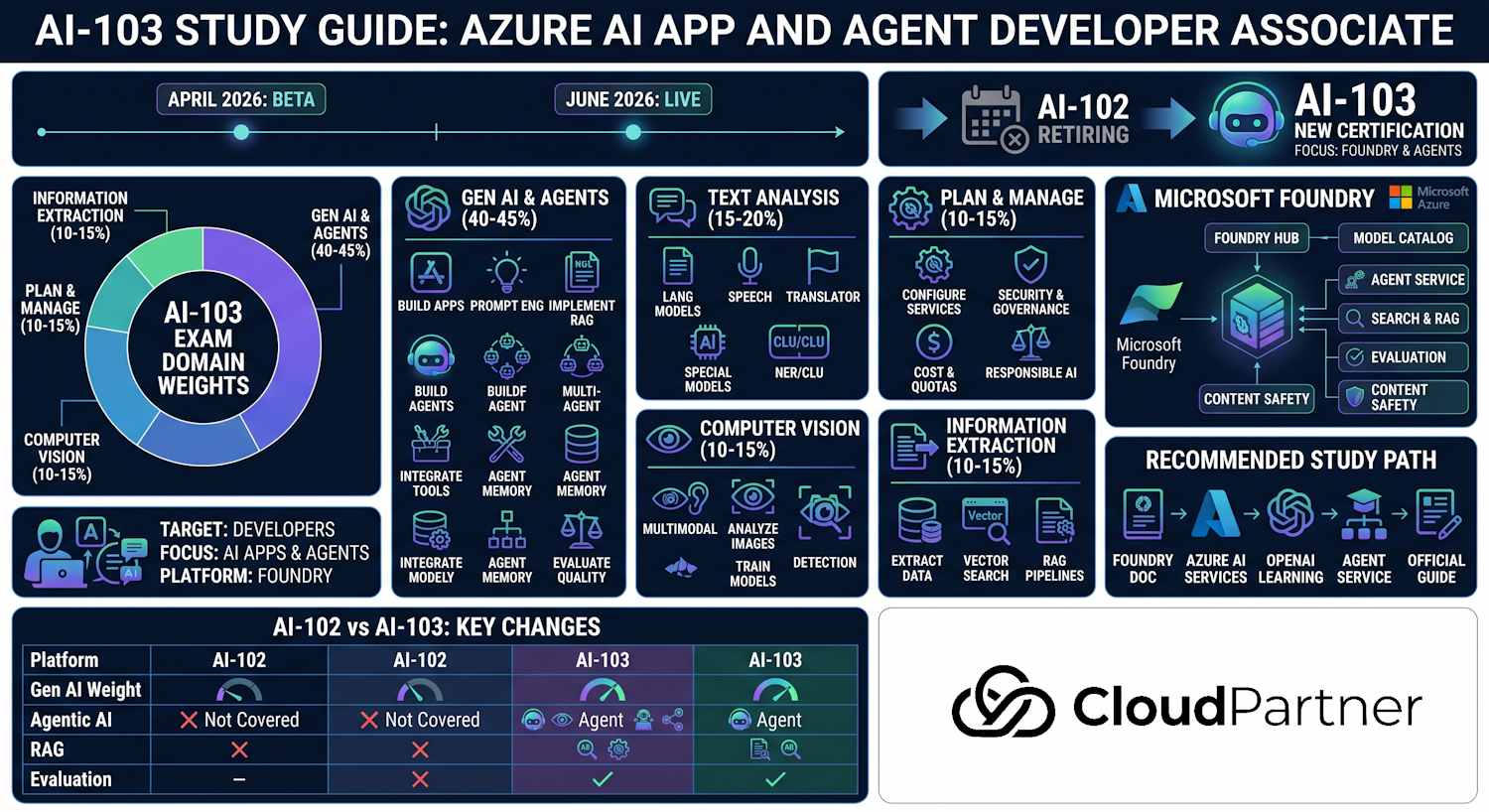
New certification: AI-103 is the successor to AI-102. The beta exam opened in April 2026, with the exam going live in June 2026. It replaces the Azure AI Engineer Associate certification and adds a heavy focus on Microsoft Foundry and agentic AI development.
Overview
The AI-103 exam targets developers who build production-ready AI applications and agents using Microsoft Foundry and Azure AI services. Compared to AI-102, it shifts emphasis toward generative AI, prompt engineering, multi-agent orchestration, and the full Foundry platform — while still covering computer vision, NLP, and document intelligence as supporting skills.
Exam Details
| Detail | Information |
|---|---|
| Exam code | AI-103 |
| Certification | Azure AI App and Agent Developer Associate |
| Level | Associate |
| Passing score | 700 / 1000 |
| Duration | 100 minutes |
| Cost | $165 USD (varies by region) |
| Beta availability | April 2026 |
| Exam goes live | June 2026 |
| Predecessor | AI-102 (retires June 30, 2026) |
Exam Objectives
The AI-103 exam is organized into five skill domains. Together, they cover the full lifecycle of AI application development — from planning and architecture through implementation, evaluation, and responsible deployment.
Plan and Manage Azure AI Solutions (25–30%)
Design scalable, secure, and cost-effective AI solutions in Microsoft Foundry. Includes:
- Selecting appropriate models and deployment options (serverless, PTU, custom fine-tuning)
- Configuring Foundry projects, connected resources, and RBAC
- Managing quotas, costs, and monitoring model performance
- Implementing responsible AI guardrails, content safety, and evaluators
- Setting up observability with traces, tokens, latency analysis, and safety signals
Implement Generative AI and Agentic Solutions (30–35%)
Build production generative AI applications and multi-agent systems. Covers:
- Deploying and consuming foundation models (GPT-4o, o3, Llama, Phi, Mistral)
- Prompt engineering, structured outputs, and model parameter tuning
- Implementing Retrieval Augmented Generation (RAG) with embeddings and vector search
- Designing multi-step workflows, agent tools, function calling, and reasoning pipelines
- Building autonomous and semi-autonomous agents with approval controls
- Evaluating model outputs for quality, hallucination, and safety
Implement Computer Vision Solutions (10–15%)
Apply vision AI for image and video analysis. Includes:
- Image and video generation with text prompts and reference media
- Multimodal analysis using foundation models and Azure AI Vision
- Accessibility features: alt text, captions, visual question answering
- Content Understanding for visual characteristics, object detection, layout analysis
- Multimodal safety controls: unsafe-content filters, prompt injection mitigation, watermarking
Implement Text Analysis Solutions (10–15%)
Extract meaning and insights from text using generative and specialized models. Covers:
- Entity extraction, topic modeling, summarization using LLMs
- Sentiment, tone, and safety issue detection
- Translation with Azure Translator and LLM-powered workflows
- Speech-to-text and text-to-speech for agentic interactions
- Custom language models for domain-specific tasks (compliance, legal, medical)
Implement Information Extraction Solutions (10–15%)
Process and extract structured data from documents, images, and media. Includes:
- Document and media ingestion for retrieval and grounding
- Semantic, hybrid, vector, and OCR-backed retrieval pipelines
- Enrichment with built-in and custom skills for text, images, and layout
- Field extraction using OCR, Document Intelligence, and multimodal models
- Generating structured JSON and markdown outputs for downstream reasoning
Skills Measured
Plan and Manage Azure AI Solutions (25–30%)
- Select appropriate Foundry models and services for generative tasks, grounding, vector search, multimodal processing, and agent workflows
- Choose retrieval, indexing, memory, tool, and knowledge integration patterns for agent solutions
- Configure AI Foundry projects, model deployments, agent deployments, and deployment options
- Integrate Foundry projects with CI/CD pipelines
- Manage quotas, scaling, rate limits, and model or agent cost footprints
- Monitor model performance, drift, safety events, grounding quality, ingestion quality, search health, and relevance performance
- Configure managed identity, private networking, keyless credentials, and role policies
- Implement responsible AI with safety filters, guardrails, risk detection, evaluators, trace logging, provenance metadata, approval workflows, and tool-access controls
Implement Generative AI and Agentic Solutions (30–35%)
- Deploy and consume LLMs, small models, code models, and multimodal models from Foundry
- Build generative AI applications using Foundry SDKs, connectors, and project connections
- Apply prompt engineering, model parameters, structured outputs, and model-specific generation controls
- Implement Retrieval Augmented Generation (RAG) with Azure AI Search and embeddings
- Design workflows, tool-augmented flows, and multistep reasoning pipelines
- Build AI agents with roles, goals, conversation tracking, retrieval, function calling, and memory
- Integrate tools including APIs, knowledge stores, search, Content Understanding, and custom functions
- Implement orchestrated multi-agent, autonomous, and semiautonomous workflows with safeguards and approval controls
- Evaluate models and apps for fabrication, relevance, quality, and safety
- Set up tracing, token analytics, safety signals, latency breakdowns, model routing, hybrid LLM/rules orchestration, and error analysis
Implement Computer Vision Solutions (10–15%)
- Implement image and video generation from text prompts and reference media
- Configure image editing with inpainting, masks, prompt-driven modifications, and platform generation controls
- Implement video editing and video analysis workflows
- Analyze images and video using multimodal models, Azure AI Vision, and Content Understanding in Foundry Tools
- Configure concise captions, detailed captions, visual question answering, alt text, and extended accessibility descriptions
- Configure Content Understanding single-task and pro-mode pipelines for visual characteristics, objects, components, and regions
- Apply multimodal safety controls including unsafe-content filters, indirect prompt injection mitigation for text inside images, watermarking, brand rules, and prohibited-symbol detection
Implement Text Analysis Solutions (10–15%)
- Use generative prompting and Foundry Tools to extract entities, topics, summaries, and structured JSON outputs
- Configure sentiment, tone, safety issue, and sensitive-content detection
- Build translation solutions with Azure Translator in Foundry Tools or LLM-powered translation flows
- Customize language model outputs for domain tasks such as compliance summarization and domain extraction
- Implement speech-to-text and text-to-speech for agentic interactions
- Integrate speech as an agent modality, including custom speech models and audio-input reasoning
- Translate speech into other languages by using language models and Foundry Tools
Implement Information Extraction Solutions (10–15%)
- Ingest and index documents, images, audio, and video for retrieval and grounding
- Configure semantic search, hybrid search, vector search, and OCR-backed RAG ingestion flows
- Implement enrichment with built-in and custom skills for text, images, and layout
- Connect retrieval pipelines directly to workflows and agent tools
- Extract structured content with OCR, layout analysis, field extraction, Azure AI Document Intelligence, and multimodal pipelines
- Use Content Understanding to produce clean, grounded representations for agents and RAG
- Implement analyzers that generate structured or markdown outputs for downstream reasoning
Microsoft Foundry — What You Need to Know
Microsoft Foundry (formerly Azure AI Studio) is the central platform for building and deploying AI apps and agents. It is the dominant exam topic in AI-103. Key concepts:
AI-102 vs AI-103 — What Changed
| Topic area | AI-102 | AI-103 |
|---|---|---|
| Primary platform | Azure Cognitive / AI Services | Microsoft Foundry + Azure AI Services |
| Generative AI weight | ~10–15% | ~30–35% |
| Agentic AI | Not covered | Core domain — agents, tools, multi-agent |
| RAG | Introduced | Deep coverage including vector search |
| Computer vision | 15–20% | 10–15% (includes multimodal) |
| NLP / Speech | 30–35% | 10–15% |
| Document Intelligence | Part of knowledge mining domain | Information extraction domain |
| Evaluation | Not explicit | Covered — Foundry evaluators, quality metrics |
Recommended Study Path
- Microsoft Foundry documentation — start here, understand the hub/project model
- Get started with Azure AI services — Microsoft Learn path
- Develop generative AI with Azure OpenAI — Microsoft Learn path
- Azure AI Agent Service overview — agents, tools, threads
- Official AI-103 study guide — Microsoft Learn