


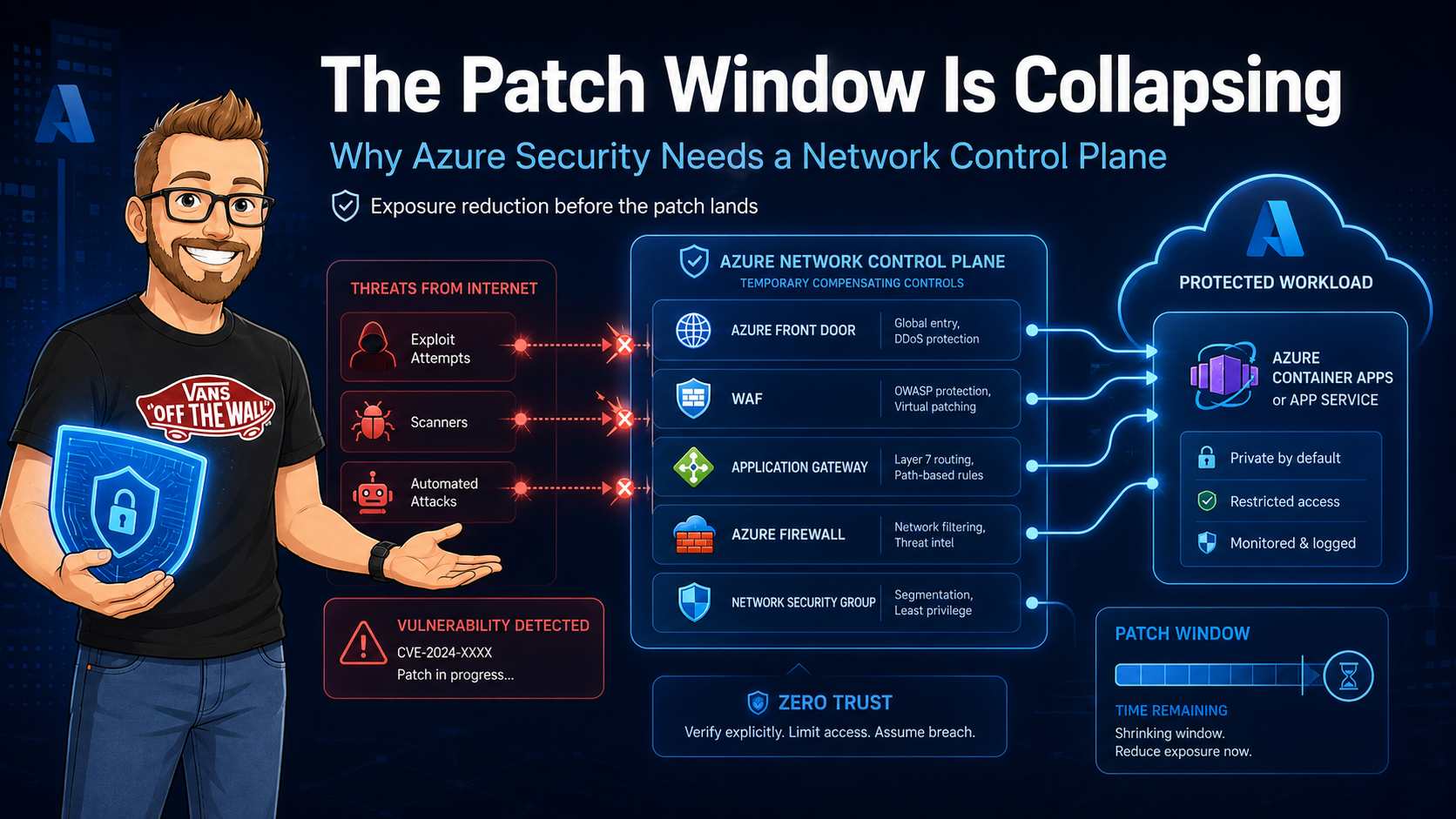
Microsoft’s latest Azure security article made me stop at a problem I have met repeatedly in cloud projects: the security finding arrives now, but the safe production change belongs to another team, another release train, or another maintenance window. The vulnerability is urgent even when the patch cannot be applied immediately.
That gap is between knowing that a workload is exposed and being able to patch it safely. I do not think the answer is to skip testing or turn every emergency into an unreviewed change. The answer is to have a second control ready for the hours or days when the permanent fix is still being prepared.
Microsoft calls attention to the network as that faster control plane. My reading is slightly more practical: the network can buy time, but only when it is tied to a specific attack path, observable evidence, and an expiry date. It reduces exposure. It does not make an unpatched component safe.
The patch window is smaller than the change process
The old vulnerability workflow assumed that defenders could move faster than attackers:
- A vulnerability is disclosed.
- The security team assesses exposure and business impact.
- Engineers test and schedule the fix.
- The patch is deployed and verified.
That model still describes the work. The timing has changed. Public proof-of-concept code, scanning infrastructure, threat intelligence, and AI-assisted analysis can move from disclosure to active probing quickly. An attacker only needs one viable path. The defender has to understand the whole environment and avoid breaking a service that people depend on.
In my own Azure work, the operational part is familiar. A Container App deployment may be quick, but the safe boundary around it still includes ingress, revisions, identity, secrets, network access, health probes, logging, and downstream permissions. The portal makes the deployment path easier to follow; it does not shorten the investigation when a dependency or network path is wrong.
Detection is not containment
Modern security platforms are good at telling us that something is vulnerable. Defender for Cloud, Defender for Endpoint, container image scanners, security recommendations, and vulnerability management tools can produce useful findings and prioritise them by severity, exposure, and asset importance.
That visibility is necessary. It is not the same as reducing exposure.
| Question | What a vulnerability platform tells you | What a control plane must do |
|---|---|---|
| Is the component affected? | Identify the vulnerable package, image, host, or service. | Connect the finding to a reachable workload and an owner. |
| Can it be patched now? | Show remediation guidance and version information. | Apply a temporary boundary if the safe change window is later. |
| What can an attacker reach? | Provide exposure or attack-path context. | Restrict routes, ports, sources, destinations, and trust relationships. |
| Did the control work? | Record the finding state. | Verify traffic behaviour, logs, health, and business impact. |
This is why a ticket that says “patch pending” is not a security control. Until the patch is installed, the temporary control needs its own owner, expiry, evidence, and rollback condition.
Why the network can act faster
The network is already in the path between clients, applications, APIs, data stores, and external services. A change at that layer can sometimes reduce exposure without changing the vulnerable application or waiting for every endpoint agent to understand the new exploit.
Depending on the attack path, a network control can:
- remove public reachability from a workload,
- restrict access to known source networks or identities,
- block a vulnerable protocol or port,
- limit lateral movement between segments,
- rate-limit abusive connection patterns,
- route traffic through WAF or inspection,
- reduce the number of systems that can reach the vulnerable component.
Microsoft uses an HTTP/2 denial-of-service example. Disabling HTTP/2 may be a blunt interim measure. A more precise response might limit concurrent streams, tighten request constraints, or rate-limit suspicious connection patterns. The principle is sound: constrain the behaviour the exploit needs while preserving legitimate service traffic where possible.
Temporary does not mean informal. A compensating network control should have a defined threat assumption, test evidence, owner, expiry date, and a clear path back to normal operation after patch verification.
What this looks like in my Azure work
My recent Container Apps work is a good example of why this matters. The new portal makes it quick to deploy an image, inspect a revision, and get a service running. That is useful during normal delivery, but it also makes the security questions arrive sooner: is ingress public, which identity does the workload use, which registry can it pull from, and which backend can it reach?
When I look at a fast-changing workload, I want more than a vulnerability score. I want to know which revision is live, whether I can move traffic back to a known-good revision, whether an origin can be reached directly, and whether the relevant logs are available. A disconnected log stream is not proof of an attack, but it is a warning that the response team needs another evidence path before trusting an automated containment decision.
This is also why I separate normal Container Apps, jobs, and isolated execution environments in a design review. They have different lifecycles and different rollback choices. Sometimes the best temporary measure is a revision rollback. Sometimes it is removing public ingress, restricting an outbound dependency, or moving untrusted execution into a more isolated runtime.
Azure control points for the gap
There is no single Azure feature called “virtual patching” that solves every vulnerability. The right control depends on where the vulnerable behaviour is exposed.
| Exposure | Possible Azure control | What it can help with | What it cannot do |
|---|---|---|---|
| Public HTTP or HTTPS application | Azure Front Door with WAF | Filter web requests, apply managed and custom rules, rate-limit, and reduce edge exposure before traffic reaches the origin. | Repair vulnerable code or protect non-HTTP paths automatically. |
| Regional HTTP workload | Application Gateway with WAF | Apply regional layer 7 inspection, routing, access restrictions, and request controls. | Replace patching or cover an exposed service that bypasses the gateway. |
| Network or application dependency | Azure Firewall, NSGs, route tables, private endpoints | Restrict flows, ports, destinations, and segmentation paths. | Understand application semantics or distinguish every malicious request. |
| Container image vulnerability | Registry scanning, policy, revision control, ingress restrictions | Prevent or limit deployment and reduce exposure while a corrected image is built. | Remove the vulnerable code from an already-running image. |
| Agent or tool call | API gateway, MCP gateway, identity policy, tool allowlist | Limit which identity can call which operation and provide a policy enforcement point. | Guarantee that the agent’s reasoning or upstream data is safe. |
This is the same layered approach I described in my MCP gateway post. The gateway becomes useful when it can identify the operation, caller, resource, and context. The network is not magic; it is a place where a decision can be enforced consistently.
Adaptive security needs context and restraint
Microsoft describes a future in which systems ingest vulnerability disclosures, correlate them with real environments, and translate the result into controls. That is the right shape for adaptive security, but the hard part is the correlation.
A CVE is not a complete risk decision. The decision also depends on:
- whether the vulnerable code path is reachable,
- whether the service is public or private,
- which identity or network can invoke it,
- whether the relevant protocol is enabled,
- what data and systems sit behind it,
- whether a control would break a critical workflow.
This is where Entra, Defender, Purview, Azure Monitor, Front Door, Application Gateway, Firewall, and workload telemetry need to work together. A security system that knows only the package version will produce a different answer from one that also knows the reachable route and business impact.
A practical operating model
I would use a short-lived exposure-reduction workflow alongside normal patch management:
- Confirm the exposure. Identify the exact asset, version, protocol, route, identity, and reachable attack path.
- Choose the narrowest temporary control. Prefer removing unnecessary reachability or constraining the exploit behaviour over taking down a whole service.
- Test the control. Verify both the blocked path and the legitimate business path. Capture logs and health evidence.
- Record ownership and expiry. The temporary rule needs a ticket, owner, reason, review date, and rollback condition.
- Patch and verify. Deploy the fixed image or package, test the application, and confirm the finding is gone.
- Remove or review the exception. Do not let an emergency restriction become permanent undocumented architecture.
The workflow should be automated where confidence is high, but high-impact changes still need approval. Blocking a suspicious source range is different from disabling a protocol used by every customer. The control should match the certainty of the evidence and the cost of being wrong.
What this is not
- It is not an argument to delay patching.
- It is not permission to call every WAF rule a virtual patch.
- It is not a replacement for secure development, dependency management, or image rebuilding.
- It is not a reason to put every workload behind a complicated inspection stack without understanding performance and failure modes.
- It is not automatic proof that a vulnerable service is safe because one route is blocked.
The phrase “network as a control plane” is useful only when it leads to a specific, testable action. Which traffic is allowed? Which traffic is blocked? Which identity can change the rule? How quickly can it be rolled back? What evidence proves that the control reduced exposure?
The bottom line
Microsoft is right that the patch window is collapsing. Vulnerability management has to keep improving, but the organisation also needs controls that can reduce exposure while the permanent fix is being validated and deployed.
Azure already has the building blocks: Front Door and Application Gateway WAF, Azure Firewall, NSGs, private endpoints, route controls, managed identity, revision management, Defender findings, and telemetry. The challenge is joining them to vulnerability context and making temporary controls part of a disciplined response process.
My practical recommendation is simple: patch as soon as you safely can, but design the environment so you can restrict reachability before the patch is ready. That is how a security team buys time without pretending the underlying vulnerability has disappeared.
Official Microsoft references
- The patch window is collapsing: Why security needs a new control plane.
- Azure Web Application Firewall overview.
- What is Azure Front Door?.
- What is Azure Firewall?.
- Microsoft Defender for Cloud overview.
- Azure Container Apps overview.