


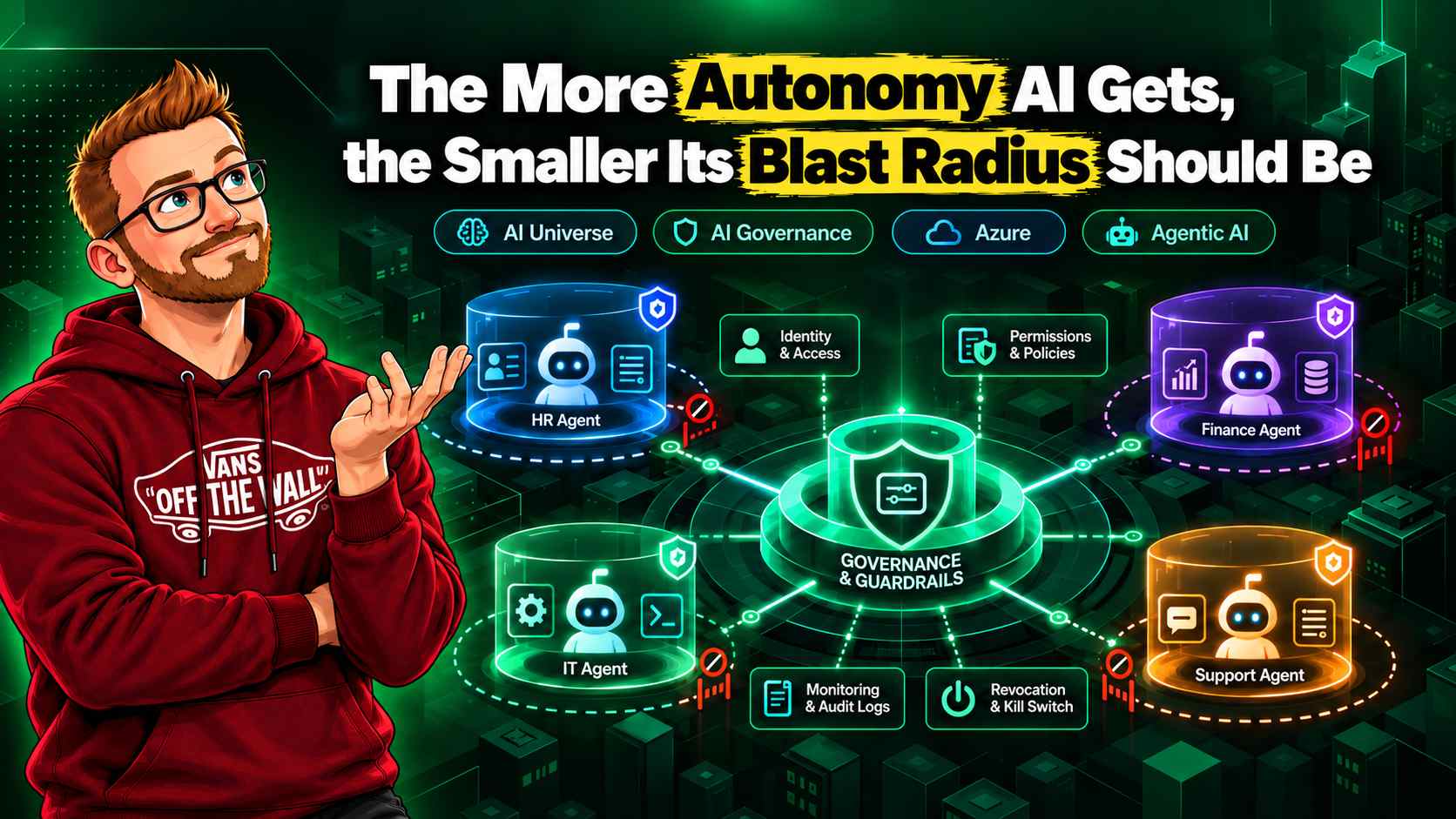
Microsoft’s 2026 Responsible AI Transparency Report contains a useful change in emphasis. The question is moving beyond whether an individual model is safe. It is becoming a question about the whole system around the model: what it can access, which tools it can call, what it remembers, and which actions it can take over time.
That is the problem with agentic AI. A chatbot that produces a bad answer is one kind of incident. An agent with an identity, permissions, tools, memory, data access, and the ability to change something is a different security problem.
Microsoft is describing the governance challenge at industry scale. AI Universe is one concrete Azure architecture for dealing with it. That is not a claim that Microsoft has validated or endorsed AI Universe. The connection is simpler: the report describes the controls; AI Universe shows how those controls can be assembled into a working application platform.
Responsible AI is no longer only a model question
Traditional AI risk reviews could focus on a model, its training data, and a defined use case. Modern applications are more connected. They combine models with external tools, data sources, services, and other models. Agentic systems add persistence and autonomy, so the system can plan across steps and act through integrations.
Microsoft’s report says risk is increasingly shaped by how systems are assembled, how access and permissions are scoped, how behavior changes through use and memory, and how actions are chained together over time. That makes a point-in-time model assessment necessary but insufficient.
The unit of control is changing: do not only ask what the model can generate. Ask what the connected system can reach, remember, and do.
The report’s response includes verifiable agent identities, runtime policies, approval gates, telemetry on actions and policy events, and the ability to activate, block, or revoke agents. It also describes evaluation of tool selection, tool-call accuracy, guardrails, and end-to-end execution.
Where AI Universe fits
AI Universe is presented by Fortytwo as a governed application platform deployed inside the customer’s own Azure subscription. It provides a control plane for building applications, connecting tools and systems, and delivering repeatable application environments.
Fortytwo also considers the broader build-or-buy decision in AI governance: Build or buy the foundation for AI?. Here, I’m looking at the trust boundaries that an AI application foundation needs to make clear.
The useful part is not the product name. It is the separation of responsibilities around each application. The platform page describes a governed core with shared policy and model access, while each application environment receives its own identity, secrets, data context, deployment path, and operational records.
One governed core, many application environments
Control plane, Azure API Management, model access policy, shared guidance, and platform-level governance.
Own Entra application identity, Key Vault secrets, repository, resources, logs, costs, and independent revocation.
Repeatable application environments with the same governance baseline but separate operational boundaries.
Shared governance does not require shared application credentials or one giant blast radius.
Three boundaries that should not be confused
When people hear that a platform runs in the customer’s tenant, they sometimes treat that as the whole isolation story. It is one important boundary, but it answers only one question: who owns and controls the surrounding Azure environment?
- Organisation boundary: AI Universe is deployed into the customer’s Azure subscription. The customer owns the Azure resources, repositories, identities, secrets, data, and logs described by the platform architecture.
- Application boundary: each application environment gets its own Microsoft Entra application identity and Key Vault secrets. A problem in one application should not automatically grant the same identity or credentials to every other application.
- Model and tool boundary: applications send approved AI traffic through a governed Azure API Management gateway, where model access, token limits, Content Safety, policy, and usage logging can be managed centrally.
These boundaries solve different trust problems. Tenant ownership protects the organisation from depending on an external application platform for control of its environment. Application isolation limits the spread of a compromise or misconfiguration. Gateway governance limits what applications can call and records what happened.
Tenant ownership protects the organisation from the platform provider. Application isolation protects applications from each other. Gateway controls protect the model and tool path.
What the control path looks like
A practical AI application request should have more context than “send this prompt to a model.” The platform needs to know which application is asking, which user or process initiated the work, which model and tools are allowed, what policy applies, and what evidence must be recorded.
From idea to governed action
Start from a repository, application template, Bicep infrastructure, and a security-gated CI/CD path.
Use the application’s identity and Key Vault-backed credentials. Route permitted AI calls through the governed gateway.
Record AI calls, token usage, cost, policy events, tool activity, deployment results, and failures in the customer environment.
The important control is the chain of evidence from application identity to model call, tool use, deployment, and result.
That does not make an agent safe automatically. It makes the security and governance questions answerable. The team can revoke one application, change a policy at the gateway, inspect the deployment pipeline, or investigate a sequence of tool calls without treating the entire AI estate as one inseparable object.
Isolation is not magic, and it is not a separate tenant for everything
AI Universe’s isolation model is not the same as giving every application a completely separate Azure tenant. That would increase administrative and operational overhead quickly. The more useful pattern is shared governance with isolated application environments.
The shared layer is where a platform team can set common controls, operate the gateway, maintain templates, and deliver updates. The application layer is where identity, secrets, code, data context, logs, costs, and revocation remain separate. This is the same reason a well-designed landing zone separates central policy from workload ownership.
There are still questions to verify in a real deployment: which resources are shared, which are dedicated, how network paths are restricted, how data is retained, which model provider processes inference, and what “kill” means for running workloads. The architecture is a boundary design, not a substitute for threat modeling and deployment evidence.
Why this matters when agents become persistent
Microsoft’s report calls out systems that retain memory, use tools, access data, and take actions on behalf of users. Persistence changes the operational question. A bad response can be corrected in the conversation. A bad action may create a record, change a permission, send a message, deploy code, or expose data.
That is why identity, runtime policy, observability, and response need to be designed together. Identity answers which application or agent acted. Permissions answer what it was allowed to reach. Runtime policy answers whether this action is permitted now. Logs answer what happened. Revocation and approval gates answer how people intervene.
AI Universe’s stated value is that these concerns are part of the application foundation rather than a security review added after the first successful demo. The practical test is whether the deployed environment really produces the identities, policy decisions, logs, and independent controls that the architecture promises.
The bottom line
Microsoft’s 2026 report is not a product endorsement for AI Universe. It is a useful description of where responsible AI is heading: away from static model review alone and toward continuous governance of interconnected systems.
AI Universe is interesting because it turns that argument into a platform shape: one governed core, many application environments, per-application identity, controlled model access, security-gated delivery, and application-level observability.
My view is straightforward: if an AI system can act, it should not inherit an unlimited trust boundary. Give it the smallest useful identity, the narrowest useful permissions, a visible execution path, and a way to stop one application without stopping everything else.
Sources and further reading
- Microsoft, Responsible AI Transparency Report 2026
- Microsoft, Responsible AI Transparency Report overview
- Fortytwo, AI Universe
- Fortytwo, AI governance: Build or buy the foundation for AI?
- Microsoft On the Issues, Responsible AI in 2026: How we are adapting for what’s ahead