


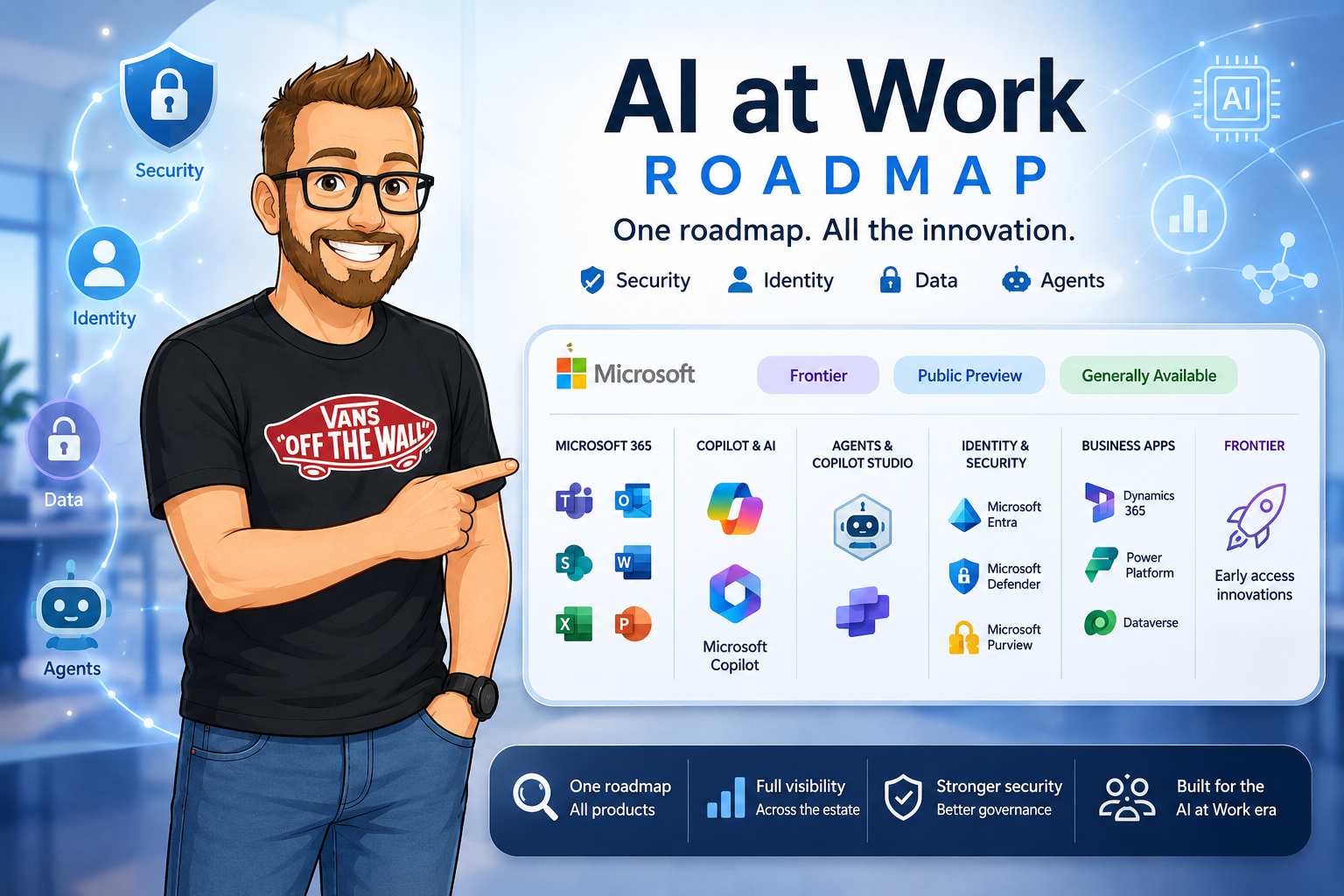
Microsoft has made a change to one of the resources many administrators check every week. The Microsoft 365 Roadmap is becoming the Microsoft AI at Work Roadmap.
That sounds like a rename, but the useful change is the scope. Microsoft is bringing release information for Microsoft 365, Copilot, agents, identity, security, and business applications into a more connected roadmap experience. For security teams, this can become an early signal for changes to identity, permissions, data paths, and agent execution.
This is an update to the release-intelligence picture, not a claim that one roadmap replaces every Microsoft operational channel. Roadmap entries describe product direction and rollout information. Message Center still tells you what is relevant to your tenant. Service Health tells you what is failing now. Microsoft Learn explains how a released capability works.
From Microsoft 365 Roadmap to AI at Work
The new roadmap keeps the familiar fields: feature IDs, preview dates, rollout dates, products, platforms, cloud instances, release phases, and status. The product filters now reflect how Microsoft solutions are assembled in practice, including:
- Microsoft 365 and Microsoft Copilot
- Microsoft Copilot Studio and Microsoft Agent 365
- Microsoft Entra and Microsoft Purview
- Microsoft Defender for Office 365 and Microsoft Intune
- Teams, SharePoint, Exchange, and related business applications
An agent can authenticate through Microsoft Entra, retrieve information from Microsoft 365, query Dataverse, call a Power Platform connector, invoke Microsoft Graph, and send an output into Teams or SharePoint. Purview and Defender then become part of the protection model. A product-by-product release tracker is a poor fit for that kind of workflow.
The security question has changed: do not only ask which product is getting a feature. Ask which identity, data, permission, or execution path is changing.
Business applications are entering the same view
Microsoft is also moving Dynamics 365, Power Platform, and Dataverse release information toward the AI at Work Roadmap. The material supplied for this post identifies September 2026 as the expected migration period and November 15, 2026 as the planned retirement date for Release Planner and the older Wave 1 and Wave 2 experience.
Those exact dates currently come from the supplied screenshot rather than a Microsoft announcement I could verify independently. I would therefore treat them as planning signals until Microsoft publishes the final retirement notice. The direction itself is clear: the older twice-yearly release-plan model is moving toward a more continuous release view with stages such as In development, Preview, Rolling out, and Generally available.
For security architecture, the change is logical. Consider a Copilot Studio agent that uses an Entra identity, Dataverse records, Power Automate, Microsoft Graph, SharePoint, Teams, and Purview policies. It does not belong to one release planner anymore. The security boundary crosses the whole chain.
The roadmap is a security architecture signal
My earlier posts on Entra Agent ID, Agent 365 governance, and Defender for AI agents looked at the controls after they appeared. The roadmap helps you see the next control or the next new exposure before it reaches production.
| Watch area | Questions for security review | Typical Microsoft surfaces |
|---|---|---|
| Identity | Does an agent get a new identity, authentication method, sponsor, lifecycle, or Conditional Access path? | Microsoft Entra, Agent ID, workload identity |
| Permissions | Can an agent call a new API, connector, flow, MCP server, or Graph permission? | Graph, Power Platform, Copilot Studio, MCP |
| Data | Can an agent discover, generate, label, retain, or share a new class of content? | Purview, SharePoint, Dataverse, Microsoft 365 |
| Execution | Can the agent act without a user, chain another agent, or trigger an irreversible workflow? | Agent 365, Copilot Studio, Foundry, Power Automate |
| Monitoring | Will activity appear in audit, Defender, Insider Risk, DLP, or observability records? | Defender, Purview, audit logs, Agent 365 |
The roadmap becomes useful when these questions are connected to your own control inventory. A new connector is not just a connector update. It may change authorization, data residency, DLP coverage, logging, and incident response.
Microsoft is making release data machine-readable
The Microsoft Release Communications MCP Server exposes public release information for Microsoft 365 Roadmap and Azure Updates to MCP-compatible clients. Microsoft documents tools for recent roadmap items, individual roadmap records, Azure updates, and individual Azure update records.
The public service can filter by products, platforms, cloud instances, status, availability dates, and publication dates. Microsoft says no authentication or license is currently required and that the underlying release information is refreshed daily. That creates a practical path for release monitoring to become an internal assistant rather than a weekly browsing task.
A security team could ask:
- Which Entra, Purview, Defender, Copilot Studio, and Agent 365 capabilities entered public preview in the last 30 days?
- Which roadmap changes affect non-human identities or agent permissions?
- Which new capabilities need a data protection or threat-model review?
- Which upcoming changes should be tested in a controlled tenant before rollout?
The answer still needs human review. A machine-readable release record can find candidates and compare them with an internal control catalogue. It cannot decide whether a feature is acceptable for a regulated workload without your context.
Roadmap data is not tenant change management
Microsoft's modern change-management guidance is important here because administrators often mix these channels together.
| Source | What it answers | How I would use it |
|---|---|---|
| AI at Work Roadmap | What Microsoft is building or rolling out. | Scan future identity, data, agent, and security changes. |
| Azure Updates | What is changing across Azure services. | Track platform dependencies and Azure control-plane changes. |
| Message Center | What Microsoft says will affect your Microsoft 365 tenant. | Assign owners, assess impact, and plan communications. |
| Service Health | What is happening operationally right now. | Respond to incidents, advisories, and active service issues. |
| Microsoft Learn | How a capability works and how to configure it. | Validate prerequisites, limits, permissions, and supported scenarios. |
A roadmap item is not a change ticket. A Message Center post is not a security design. A Learn article is not proof that your tenant has received a feature. Keeping those distinctions intact prevents a lot of false confidence.
Frontier, Preview, and GA need different controls
The AI at Work Roadmap also brings Microsoft's Frontier programme into the release conversation. Frontier is an early experimentation environment. A capability may change substantially or never reach general availability.
That should translate into separate internal treatment:
- Frontier: experimentation with test data, limited users, explicit owner, and no production dependency.
- Public Preview: controlled evaluation with a threat model, logging review, rollback plan, and documented limitations.
- Generally available: normal production intake, architecture review, policy mapping, and service ownership.
This is especially important for autonomous agents, new connectors, new models, external data sources, and capabilities that allow an agent to take action. The earlier security joins the evaluation, the less likely a team is to discover a new permission or data path after deployment.
Build a security feed from the roadmap
I would start with a small process instead of trying to monitor every Microsoft product equally:
- Filter the roadmap for Entra, Agent 365, Copilot Studio, Purview, Defender, Microsoft 365, Power Platform, Dataverse, Teams, and SharePoint.
- Use the MRC MCP Server to collect new and changed entries on a schedule.
- Classify each entry as identity, permissions, data, execution, monitoring, or operational change.
- Compare the result with your agent inventory, control catalogue, and high-value data flows.
- Send only the entries that need action to the responsible security, identity, platform, or compliance owner.
- Confirm tenant impact through Message Center and technical detail through Microsoft Learn.
This process is small enough to run now and flexible enough to grow with the roadmap. It also fits the governance pattern Microsoft describes for Agent 365: establish visibility first, then add rules and automation once the signals are trusted.
The bottom line
The Microsoft 365 Roadmap becoming the AI at Work Roadmap reflects a real change in how Microsoft products are used. Microsoft 365, Copilot, agents, identity, data, Azure, and business applications are increasingly parts of the same workflow.
For security architects, the roadmap should become part of change intelligence. Watch for new identities, permissions, data paths, execution methods, and monitoring controls. Use the MRC MCP Server to make that watch repeatable, but keep Message Center, Service Health, and Microsoft Learn in the process.
A new feature can quickly become a new non-human identity, a new authorization path, a new data boundary, or a new attack surface. Seeing that change early gives the security team time to ask the useful questions before the rollout becomes somebody else's incident.
Official Microsoft references
- Microsoft AI at Work Roadmap.
- Microsoft Release Communications MCP Server.
- Modern change management for Microsoft 365.
- Power Platform 2026 release plan, useful background for the earlier release-plan model.
- Overview of Microsoft Agent 365.