


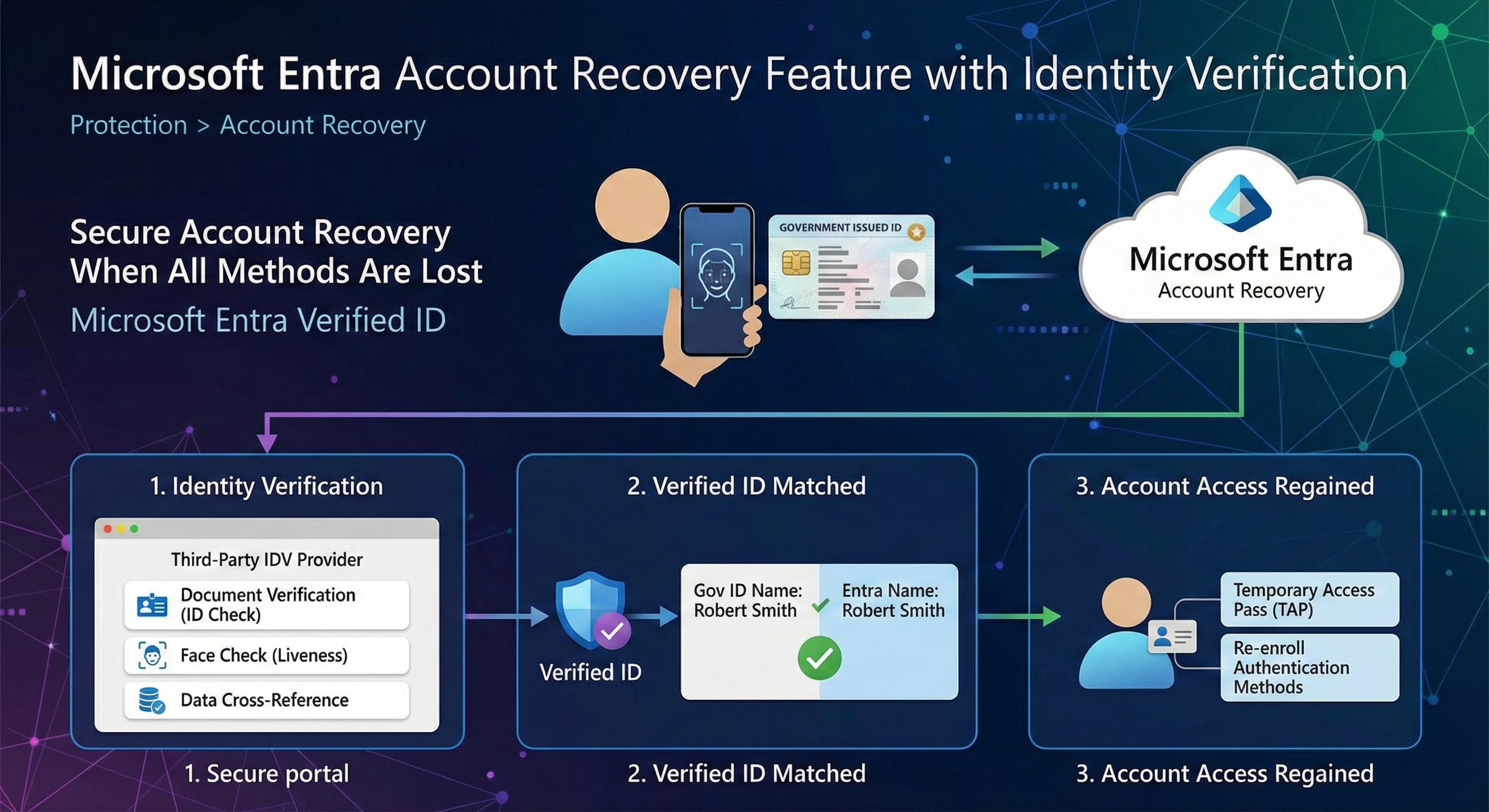
Part 2 of the series. In Part 1 I focused on setup and implementation. This one is about where the feature is heading, what policy-driven matching could realistically look like, and what it means for European organizations that need strong security and clean governance at the same time.
Read Part 1: Setup, Operations, and Claims API Foundation
A Practical Way to Read This Part
If you are an identity architect, read this as policy design. If you run operations, read it as runbook planning. If you own legal or procurement review, read it as control-boundary design. The same feature looks very different depending on your role, and that is exactly why this second part needs more depth.
My goal is simple: connect product behavior to real tenant decisions, not abstract theory. Who gets self-service recovery, where manual approval is still required, what gets logged, what should alert, and how you explain a failed attempt to both audit and the user.
Why Part 2 Matters
Part 1 explained how the feature works today. That is useful, but it does not answer the questions most architecture and security teams end up asking after the demo. Is name matching enough for a large tenant? How do you handle a failed match where the person is probably legitimate? What should your policy look like for employees, contractors, and privileged admins? And in Europe, where does responsibility actually sit when identity proofing, biometrics, and account recovery all meet in one workflow?
This is where things get real. A recovery feature is not just a sign-in rescue path. It becomes part of your assurance model. If it is too weak, you open a takeover route. If it is too strict, users go straight back to manual helpdesk recovery and self-service loses value. The hard part sits in the middle: choose the right evidence, define clean failure paths, and keep decisions explainable for audit, legal, and users.
What Feels Incomplete Today
Even if the current model is promising, there are still gaps that matter in real deployments. None of these are deal-breakers on their own, but together they explain why many organizations will test the feature carefully before treating it as a primary recovery control.
- Name matching is only a starting point: In big tenants, duplicate or near- duplicate identities are normal. Shared surnames, transliteration differences, middle names, and local legal naming patterns all make single-dimension matching less comfortable at scale
- Profile hygiene becomes security-critical: If your Entra user objects are not maintained consistently, the recovery flow does not just become messy. It becomes unreliable, which then becomes a security and operations issue
- Failure handling is still under-discussed: A good product story cannot stop at "match succeeded." We also need predictable behavior for partial matches, stale records, provider outages, and cases where biometrics fail even though the person is legitimate
- Regional trust expectations differ: In Europe especially, users, regulators, and works councils often ask harder questions about biometric use, retention boundaries, cross-border transfers, and processor responsibilities than many product teams first expect
My Assumption: Where This Could Go Next
This is my own read of the direction, not Microsoft documentation. Based on what I have tested, I expect Account Recovery to move from basic matching toward more context-aware decisions, without making recovery painfully slow for real users.
Possible Matching Evolution
Right now, matching quality still depends heavily on profile hygiene and naming consistency. My assumption is that the next meaningful step is optional multi-claim matching for tenants that need higher confidence.
| Maturity Stage | Matching Model | Expected Strength | Trade-off |
|---|---|---|---|
| Baseline match | First name + Last name | Good baseline | Can still collide in large enterprises |
| Strengthened match | Name + Date of birth | Much better uniqueness | Relies on cleaner source data and governance |
| Policy-driven match | Name + Date of birth + additional verified claim | Very high confidence | More integration effort and policy design |
Why I Think This Is Realistic
What gives me confidence is that the building blocks are already visible in available claims matching implementations: pluggable validation providers, dynamic claim sets, and explicit claim-by-claim fail responses. That means the path from basic matching to policy-driven matching is mostly a governance and product-hardening journey, not a theoretical rewrite.
I also expect identity anchors such as user principal name and employee ID to stay central for lookup, with extra verified claims layered on top for higher assurance tiers.
What Good Policy Design Could Look Like
If this feature matures the way I expect, the biggest win will not be just "more claims." It will be better policy separation. Different populations should not share one recovery policy just because they live in the same tenant.
| Population | Suggested Recovery Strength | Why It Fits | What I Would Add |
|---|---|---|---|
| Standard workforce | Name match plus verified selfie and government ID | Good balance between speed and assurance | Fast audit logging and clear post-recovery alerts |
| Contractors and external users | Name plus additional verified claim | Records are often less consistent and identity proofing varies | Shorter TAP lifetime and mandatory manager notification |
| Privileged admins | Strongest available policy or no self-service recovery at all | Privilege recovery should be much harder than user recovery | Separate break-glass process, security review, and just-in-time elevation |
| Highly regulated roles | Policy-driven multi-claim recovery with human approval option | Auditability matters as much as raw confidence | Documented decision trail and region-specific data handling controls |
That separation matters because recovery is not only about identity proof. It also resets the trust level of the session that follows. If a privileged user gets back in through a weaker flow than the one you require for daily admin operations, your control story starts to look inconsistent very quickly.
Failure Paths Matter as Much as Success Paths
One thing I would like to see discussed more openly is what happens when the process does not land cleanly. Real users are messy. Cameras fail. Legal names differ from HR records. Some people have old passport photos that do not look much like them anymore. An enterprise-ready recovery system needs to be trusted not only when it approves, but also when it rejects.
For me, a mature design should handle at least these cases clearly:
- Hard fail: Evidence is weak or obviously inconsistent, so recovery is denied and logged for review
- Soft fail: The user probably is genuine, but one claim does not match cleanly, so the system steps up to a stricter path or asks for manual review
- Operational fail: The provider, API, or dependent validation path is degraded, so the system should fail safely and not quietly lower assurance to keep the workflow moving
- Post-recovery risk: Even after success, the account may need tighter session controls, rapid method re-registration, anomaly checks, and strong user notifications
This is where I think product teams can make a big difference. If the admin experience exposes why a recovery attempt failed, which claim failed, and what the next valid branch is, operations teams can build a proper runbook around it. If it only says "match failed," the burden lands straight back on the helpdesk.
What This Means for Us in Europe
From a European perspective, this is bigger than a technical recovery feature. It touches legal accountability, processor relationships, and employee trust. If Microsoft gets this balance right, I can see it becoming normal practice in regulated sectors.
- Compliance posture: A verifiable recovery trail is useful in audit-heavy sectors like finance, healthcare, and government
- Data governance and residency: We still need strict data minimization, clear retention boundaries, well-defined processor terms, and explicit cross-border transfer clarity for EU procurement and audits
- Identity ecosystem fit: As EU digital identity programs evolve, there is a real opportunity to align enterprise account recovery with trusted credential frameworks
- Operational realism: Even with good automation, we should keep a human fallback for legal exceptions and biometric failure cases
- Reliability is part of policy: If claims APIs cannot meet low-latency and high-availability expectations under load, recovery policy fails in real incidents even when matching logic is correct
My take: in Europe, this only wins long term if it delivers three things together: explainable policy decisions, clear data-boundary controls, and resilient low-latency validation paths. If those land, it can reduce recovery fraud materially and cut helpdesk dependency without sacrificing governance.
Questions I Would Ask Before Approving It in an EU Tenant
If I were reviewing this for a European customer today, these are the practical questions I would want answered before broad rollout:
- What exact claims are processed, by whom, and for how long? The answer needs to be precise enough for privacy review, not just marketing-level wording.
- Where does biometric comparison happen? Data residency, subprocessors, and transfer paths need to be clear enough for legal and procurement teams to evaluate.
- Can policy vary by user population? If the answer is effectively no, then the feature may fit workforce recovery but not privileged identity recovery.
- What do the logs show? Audit records should help explain the decision without exposing more personal data than operations teams need.
- What is the outage story? If the IDV provider or claims validation path is unavailable during a real incident, the fallback process must already be defined.
Those questions are not anti-cloud and they are not anti-innovation. They are normal when identity proofing meets regulated operations. A product can be excellent and still require careful paperwork. In Europe, both are often true at the same time.
What I Hope Microsoft Exposes Next
If Microsoft keeps pushing this forward, I think a few additions would make the feature far easier to defend in architecture reviews:
- Claim-level policy templates: Let admins define assurance tiers instead of just one generic recovery path
- Better audit semantics: Show which policy branch ran, which evidence passed, and which evidence failed, without turning the log into a privacy problem
- Population scoping: Make it easy to separate workforce, external identities, and privileged roles
- Safer post-recovery controls: Force tighter TAP windows, re-registration rules, or conditional checks automatically after successful recovery
- Regional compliance profiles: Give customers a cleaner way to map technical settings to procurement, privacy, and regulatory review requirements
If those pieces arrive, the conversation changes fast. Then this is not only a smart recovery feature. It becomes a policy-driven assurance control that can stand next to the rest of an enterprise access strategy.
The Bottom Line
I still think Microsoft Entra Account Recovery is heading in the right direction. The basic idea is strong: recover access using verified real-world identity instead of hoping the user still has a backup MFA method somewhere. But the real success of this feature will depend on how well Microsoft handles policy separation, failure transparency, regional governance, and post-recovery security controls.
For smaller organizations, the current path may already be enough for a serious pilot. For larger or regulated environments, I would treat it as a strong foundation that still needs careful design around data quality, role segmentation, and legal review. That is not criticism. That is just the practical reality of turning identity proofing into an enterprise-grade recovery control.
External References and Sources
- Microsoft Entra self-service account recovery FAQ
- How to enable Account Recovery in Microsoft Entra
- Microsoft Entra Verified ID overview
- Microsoft Entra Verified ID Face Check
- Temporary Access Pass in Microsoft Entra
- Passwordless sign-in methods and phishing-resistant authentication in Microsoft Entra
- NIST guidance on MFA and assurance considerations
- EU eIDAS Regulation (Regulation (EU) No 910/2014)
Series Navigation
This is the second post in the series.