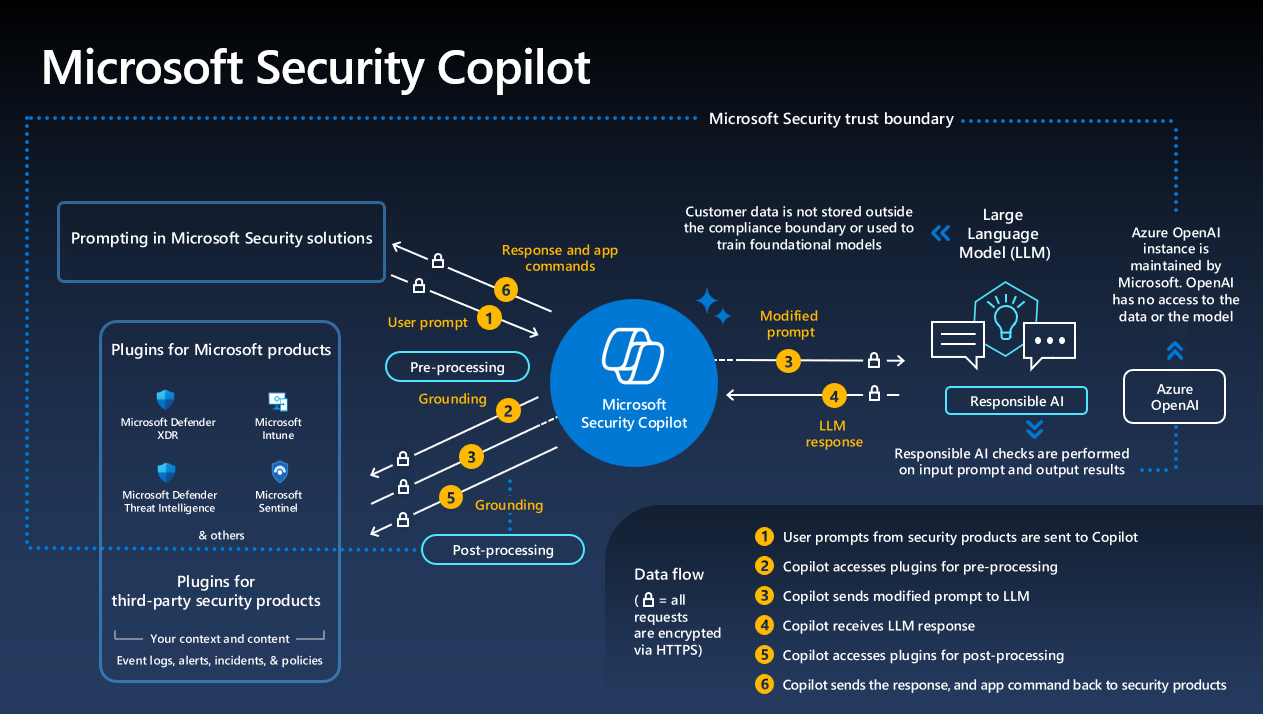
Security teams investigating data incidents face a persistent challenge: the volume of data across enterprise environments makes manual analysis slow, error-prone, and incomplete. Microsoft's deep content analysis capabilities in Microsoft Security Copilot address this directly — bringing AI-powered analysis into investigations that previously relied on keyword searches and manual review. This post examines how these capabilities work and what the new SCU licensing model means in practice.
The Challenge: Information Overload in Security Investigations
Security teams face a common dilemma during investigations:
| Challenge | Impact | Traditional Approach |
|---|---|---|
| Information overload | Delayed response times | Manual review of documents |
| Resource limitations | Incomplete investigations | Keyword-based searches |
| Complex data formats | Missed critical insights | Limited classification capabilities |
| Time constraints | Increased security risks | Sequential document analysis |
With organizations generating and storing vast amounts of data across diverse platforms, security teams struggle to quickly identify, analyze, and protect sensitive information during investigations. The sheer volume of content makes traditional approaches increasingly ineffective.
Enter Microsoft Security Copilot with Deep Content Analysis
Microsoft Security Copilot's AI-powered deep content analysis represents a significant advancement in security capabilities, using AI to transform how teams investigate potential data breaches.
Key Capabilities of Security Copilot's Deep Content Analysis
| Capability | Description | Benefit |
|---|---|---|
| Advanced document understanding | Analyzes document context beyond keywords | More accurate identification of relevant content |
| Contextual awareness | Understands relationships between data elements | Reduces false positives |
| Multi-format support | Processes various file types and structures | Comprehensive investigation coverage |
| AI-powered classification | Automatically categorizes sensitive information | Faster prioritization of critical data |
| Natural language processing | Interprets human language patterns | Identifies nuanced security concerns |
| Conversational interface | Allows security teams to ask questions in natural language | Faster insights without specialized query language |
Rather than relying solely on predefined patterns or keywords, Security Copilot analyzes content with an understanding of context, relationships, and nuance similar to human comprehension but at scale.
Security Copilot's New Service Coverage Units (SCU) Model
Microsoft has recently introduced a significant update to Security Copilot's licensing model through Service Coverage Units (SCUs), providing organizations with more flexibility and value in how they deploy this AI technology.
Understanding Service Coverage Units (SCUs)
| Feature | Description |
|---|---|
| Definition | SCUs represent a new licensing model that covers multiple Microsoft Security products under a unified consumption-based approach |
| Calculation Basis | Based on the total number of assets an organization is protecting across their digital estate |
| Flexibility | Organizations purchase a pool of SCUs that can be applied across various Microsoft Security solutions |
| Consolidation | Replaces separate licensing models for individual security products with a unified approach |
SCU Coverage for Security Copilot
The new SCU model significantly expands how organizations can deploy Security Copilot across their security ecosystem:
| Aspect | Details |
|---|---|
| Comprehensive Access | SCUs provide access to Security Copilot capabilities across Microsoft Defender, Sentinel, Purview, and Intune |
| Connector Integration | Access to all available Security Copilot connectors for your licensed Microsoft Security products |
| Data Source Coverage | Automatically includes data from all Microsoft security products covered by your SCUs |
| Scaling Flexibility | Add additional SCUs as your organization grows or security needs expand |
| Predictable Costs | Simplified licensing model makes budgeting for AI security tools more straightforward |
Benefits of the SCU Model for Security Investigations
The introduction of SCUs enhances security investigations by:
- Streamlining access to data sources: Security teams can access data from multiple Microsoft security products without worrying about separate licensing constraints
- Enabling cross-product analysis: Investigations can seamlessly span across Microsoft Defender, Sentinel, Purview, and other products
- Simplifying licensing decisions: Organizations can focus on their security needs rather than complex licensing calculations
- Supporting full coverage: Encourages deployment of Security Copilot across the security ecosystem rather than limited use cases
How Security Copilot Transforms Investigations
Security Copilot's deep content analysis transforms investigations by:
- Augmenting human expertise: Acting as an intelligent co-pilot that helps security analysts process and understand vast amounts of data
- Providing conversational access to insights: Allowing analysts to ask questions in natural language about the data under investigation
- Connecting disparate information: Identifying relationships between data points that humans might miss
- Accelerating decision-making: Providing rapid, contextual analysis that helps teams respond more quickly
Real-World Applications
Scenario: Investigating a Potential Data Leak
A security team receives an alert about potential unauthorized access to sensitive customer information. Using Security Copilot's deep content analysis, they can:
- Quickly identify affected documents: Security Copilot can analyze thousands of files to determine which contain sensitive customer data, even if not explicitly labeled
- Understand data relationships: The system recognizes connections between seemingly unrelated documents that contain fragments of sensitive information
- Assess exposure scope: By understanding document context, Security Copilot accurately determines which sensitive elements were potentially compromised
- Prioritize response actions: The team receives a prioritized list of the most sensitive exposed information
Performance Improvements with Security Copilot
| Metric | Traditional Approach | With Security Copilot | Improvement |
|---|---|---|---|
| Investigation time | 24-48 hours | 1-3 hours | 80-95% reduction |
| Document analysis capacity | 100-200 per day | 10,000+ per day | 50x increase |
| Accuracy in identifying sensitive content | 60-70% | 90-95% | ~30% improvement |
| False positive rate | 15-25% | 3-8% | ~70% reduction |
| Time to insight | Hours/days | Minutes | Up to 97% reduction |
Implementation Best Practices for Security Copilot
For organizations looking to leverage Security Copilot's capabilities, consider the following best practices:
- Start with clear investigation objectives: Define what types of sensitive information are most critical for your organization
- Integrate with existing security workflows: Ensure Security Copilot complements your current investigation processes
- Establish baseline metrics: Measure current investigation performance to quantify improvements
- Train security personnel: Ensure team members understand how to effectively interact with Security Copilot
- Develop effective prompting techniques: Learn how to ask questions that yield the most valuable insights
- Continuously refine use cases: Identify which types of investigations benefit most from AI assistance
- Optimize SCU allocation: Regularly review your SCU utilization to ensure optimal coverage across security tools
Security Copilot's Role in the Microsoft Security Ecosystem
| Microsoft Security Solution | How Security Copilot Enhances It | SCU Coverage |
|---|---|---|
| Microsoft Purview | Enhances data classification and protection with deeper contextual understanding | Included with SCUs |
| Microsoft Defender | Accelerates threat hunting and investigation processes | Included with SCUs |
| Microsoft Sentinel | Provides conversational insights into security incidents and alerts | Included with SCUs |
| Microsoft Entra ID | Assists in investigating identity-related security issues with contextual awareness | Included with SCUs |
| Microsoft Intune | Helps analyze endpoint security posture and compliance issues | Included with SCUs |
Planning Your Security Copilot Deployment with SCUs
When planning your Security Copilot deployment with the new SCU model, consider:
- Asset inventory: Complete an inventory of your digital assets to understand your SCU requirements
- Priority use cases: Identify which security investigation scenarios will benefit most from Security Copilot
- Team readiness: Ensure your security team is trained to run AI-assisted investigations effectively
- Integration planning: Map how Security Copilot will integrate with your existing security operations
- SCU optimization: Determine the most efficient allocation of SCUs across your security tools
Privacy and Ethical Considerations
While Security Copilot offers significant benefits, organizations must consider:
| Consideration | Recommendation |
|---|---|
| User privacy | Implement strict access controls for investigation data |
| Ethical use | Establish clear guidelines for when deep analysis is warranted |
| Transparency | Document analysis processes for regulatory compliance |
| Governance | Create oversight mechanisms for Security Copilot usage |
| Human oversight | Maintain human review of AI-generated insights |
Looking Ahead: The Future of AI-Assisted Security Investigations
The integration of AI through Security Copilot represents just the beginning of a fundamental shift in how organizations protect sensitive data. As these technologies evolve, we can expect:
- Predictive capabilities: Identifying potential data vulnerabilities before breaches occur
- Cross-platform analysis: Seamless investigation across cloud services, endpoints, and on-premises systems
- Automated remediation: AI-suggested actions to contain and remediate incidents
- Continuous learning: Systems that adapt to emerging threats and evolving data types
- Expanded SCU coverage: Additional Microsoft security products included in the SCU model
Conclusion
Microsoft Security Copilot with AI-powered deep content analysis is transforming security investigations from time-consuming, resource-intensive processes into streamlined, efficient workflows that provide stronger protection for sensitive data. With the new SCU licensing model, organizations can now deploy these powerful capabilities more flexibly across their entire security ecosystem.
With Security Copilot in place, security teams can respond more rapidly to potential incidents, gain deeper insights into their data landscape, and better protect their organizations from evolving threats. The SCU model removes licensing complexity as a barrier to broad AI-powered security, allowing organizations to focus on what matters most: protecting their critical assets.
Organizations that embrace Security Copilot now will not only enhance their current security posture but also build the foundation for more advanced, adaptive security practices in the future.
Learn more about the latest innovations designed to protect your data, defend against cyber threats, and ensure compliance. Join Microsoft leaders online at Microsoft Secure on April 9.
AI innovation requires AI security
- Try DSI: Global Admins can activate Purview pay-as-you-go meters and provision Security Compute Units when the public preview rolls out on April 9.
- Share feedback: Email DSIfeedback@microsoft.com with your thoughts on DSI
See the announcement here

Accelerate data security investigations with AI-powered deep content analysis | Microsoft Community Hub