


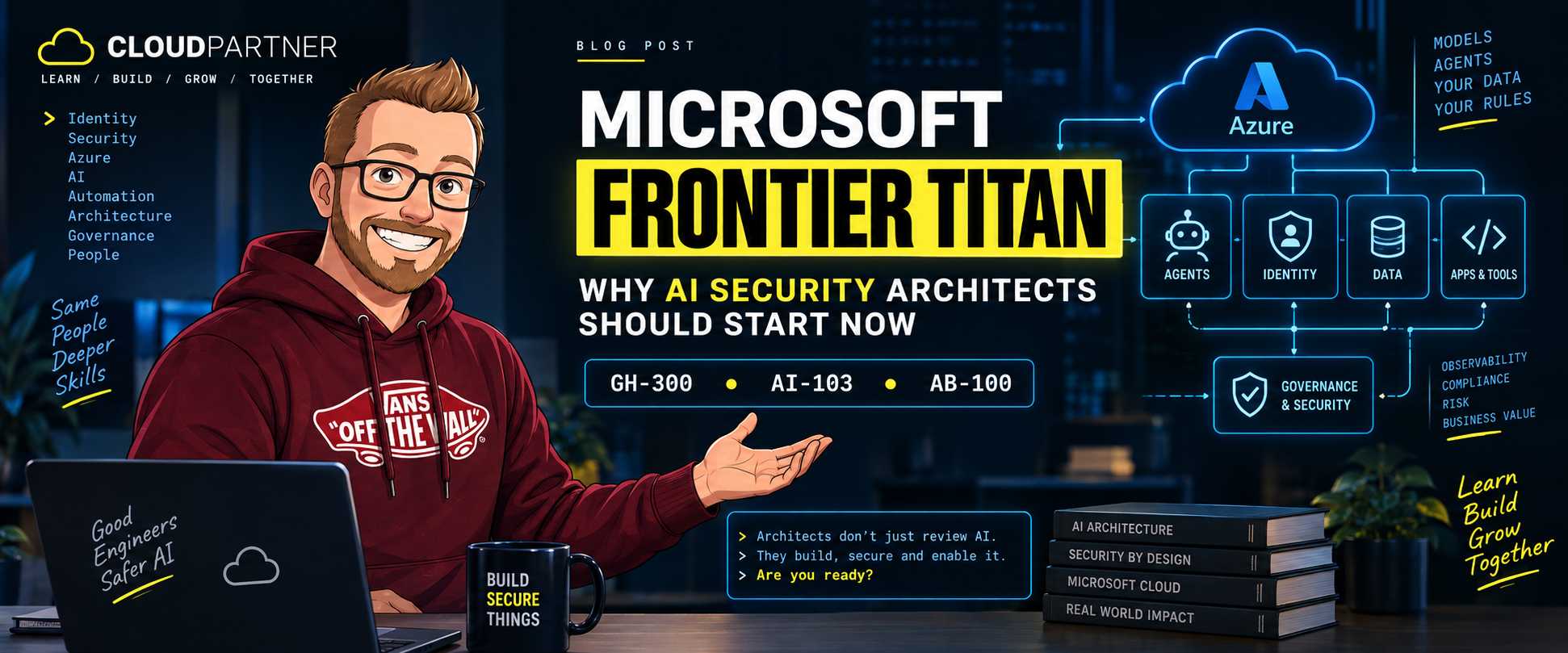
Microsoft's Frontier page calls this the Frontier Transformation Engineer badge. I use "Frontier Titan" here because that is how I think about the level of capability the track is aiming for. It is not one standalone Microsoft certification. It is a connected readiness path built from certifications, applied assessments, and engineering practice.
Why I would not postpone this
I spend a lot of time looking at AI from the security architecture side. The recurring problem is not a lack of security products. It is that the people asked to secure AI systems are often expected to review architectures they have never had to build.
That gap matters. A security architect who understands agents only as a new application risk will miss tool contracts, model deployment choices, retrieval boundaries, evaluation data, prompt manipulation, and the operational decisions that make an AI workload safe or unsafe. Reading a threat model is useful. Knowing why an engineering team chose a provisioned model deployment, a vector index, a function tool, or a multi-agent handoff is better.
That is why I think the Frontier track should move up the list for architects working with AI. It forces a wider view: build the application, understand the business outcome, assess the delivery model, and then secure the whole system. Waiting until every AI pattern is settled means waiting for a point that will not arrive.
What the Frontier Titan track actually is
The Frontier Transformation Engineer journey is organised around three milestones:

- Certifications: GH-300, AI-103 or an active AI-102, and AB-100.
- Project Ready: five applied courses and assessments, normally requiring at least 80% on each assessment.
- Frontier CoE and Hypervelocity Engineering: the required Hypervelocity Engineering Framework assessment, with the AI Center of Excellence and industry expertise courses available as supporting material.
The public journey describes roughly 86 hours across 11 courses. That number is useful, but the more important detail is the shape of the work. This is not a badge for memorising a product catalogue. It tests whether you can connect AI delivery, business change, data, agents, governance, and engineering execution.
Why this makes sense for a security architect
Security architecture is becoming a participation job. The old pattern was often to wait for a design, review it, add controls, and approve or reject the result. AI makes that sequence too late. The security decisions are embedded in product choices and workflow design from the first prototype.
The Frontier track is useful because its certification mix maps to the decisions security architects now need to challenge:
| Track component | Architecture question it helps answer |
|---|---|
| GH-300 | What context enters the Copilot or coding workflow, who can access it, and how do privacy, policy, review, and audit controls work? |
| AI-103 | How are models, agents, RAG, tools, identity, evaluation, cost, and production observability assembled into an application? |
| AB-100 | Where should an agent act autonomously, where is approval required, and how do business outcomes shape the risk tier? |
| Project Ready | Can the team turn the architecture into a working delivery approach with measurable outcomes? |
That is a much more useful security conversation than simply asking whether an AI service is approved. The real question is whether the complete system has clear boundaries, accountable actions, evidence, and failure handling.
AI-103 is the technical centre of the track
For an AI security architect, I see AI-103: Azure AI App and Agent Developer Associate as the technical centre of gravity. It covers the part of the stack where architecture and security meet most directly.
The largest exam domain, Generative AI and Agentic Solutions, covers LLM deployment in Azure AI Foundry, prompt design, RAG, function calling, code interpreter, file search, multi-agent orchestration, tracing, monitoring, and evaluation. Those are security boundaries, not just developer features.
The Plan and Manage domain adds the control plane: Foundry projects, model deployment types, quota, CI/CD, content filters, Prompt Shields, managed identity, RBAC, private endpoints, cost, and observability. That is precisely the material an architect needs when reviewing a production design.
The other AI-103 domains matter as well. Vision pipelines bring image prompt injection and content safety into scope. Text and Speech introduce data handling and domain customisation questions. Document Intelligence and Azure AI Search expose ingestion, indexing, enrichment, and grounding decisions that can quietly become data-exposure paths.
I built the Cloudpartner Academy AI-103 course around those decisions, including applied scenarios for model selection, session-scoped memory, handoffs, human approval boundaries, visual prompt injection, Custom Speech, and Content Understanding. The aim is to connect the exam topic to the design review you will actually have to lead.
GH-300 and AB-100 close the gaps AI-103 cannot
AI-103 alone does not describe the full enterprise AI operating model. GH-300 adds the developer and Copilot context. Its domains cover responsible use, Copilot features, data flow, prompt engineering, productivity, testing, security, policy, and adoption. A security architect needs this because code and knowledge workflows are becoming part of the organisation's AI control plane.
AB-100 adds the business architecture layer. It asks how to plan, design, deploy, monitor, and govern AI-powered business solutions. Its focus on human approval, agent handoffs, tool contracts, APIs, MCP, identity, authorisation, ALM, evaluation gates, rollback, and incident response is directly relevant to security architecture.
Together, the three certifications describe a system that has to survive contact with users, developers, data owners, business processes, and operations. That combination is why I would not treat the certifications as unrelated study projects.
A practical Cloudpartner Academy study route
I would approach the track in this order, adjusting it for your current experience:
- Start with AI-103. Build enough hands-on understanding to follow model, RAG, agent, identity, and evaluation discussions without relying on architecture diagrams alone.
- Use GH-300 next. Add the Copilot data-flow, privacy, policy, and developer productivity perspective. This is particularly useful if your organisation is rolling out GitHub Copilot alongside Azure AI.
- Take AB-100 after the technical foundation. The business architecture scenarios are easier to judge when you understand what the underlying agent and data services can actually do.
- Use the five Frontier project courses as implementation checks. The Microsoft IQ, Work IQ, Copilot and agents, Agentic AI, Fabric IQ and Data Agents, and Agent 365 material expands the view from one AI application to the operating environment around it.
- Finish with Hypervelocity Engineering. This is where the learning becomes a delivery and organisational question: how do teams build, govern, measure, and repeat AI delivery without turning every project into a one-off security exception?
Cloudpartner Academy already has the preparation tracks for GH-300, AI-103, and AB-100. I see them as three connected study rooms: developer and Copilot usage, AI application engineering, and enterprise business architecture.
What makes the track essential
I do not think every security professional needs every new badge. This one is different because it reflects how AI security work is changing. The architect is increasingly responsible for decisions that sit between product, engineering, identity, data, governance, and operations.
The track is useful when it changes the questions you ask:
- Which identity is used when an agent calls a tool, and is the permission scoped to the user, the agent, or the workload?
- What happens when retrieved content contains hostile instructions, sensitive data, or stale policy?
- How are prompts, model versions, tools, evaluations, and approvals changed through the release process?
- What evidence shows that a high-impact agent action is safe enough to run?
- How do cost, latency, quality, and security findings affect the decision to move from a pilot to production?
Those questions cannot be answered by a security product dashboard. They require enough practical AI knowledge to understand the system being protected.
My recommendation
If you are a security architect working with AI, I would start the Frontier track now and treat it as a capability-building programme, not a race to collect a badge. Begin with the certification you are furthest from, reserve time for hands-on work, and use the project assessments to test whether you can explain the architecture to an engineering team and a risk committee.
For most security architects, my suggested starting point is AI-103. It gives you the clearest technical view of what modern Azure AI systems actually contain. Then use GH-300 and AB-100 to widen that view across the developer workflow and the business operating model.
The reason to start now is simple: security decisions are already being made inside AI projects. The architects who understand those decisions early will have a much stronger voice in how their organisations build and govern the next generation of systems.