


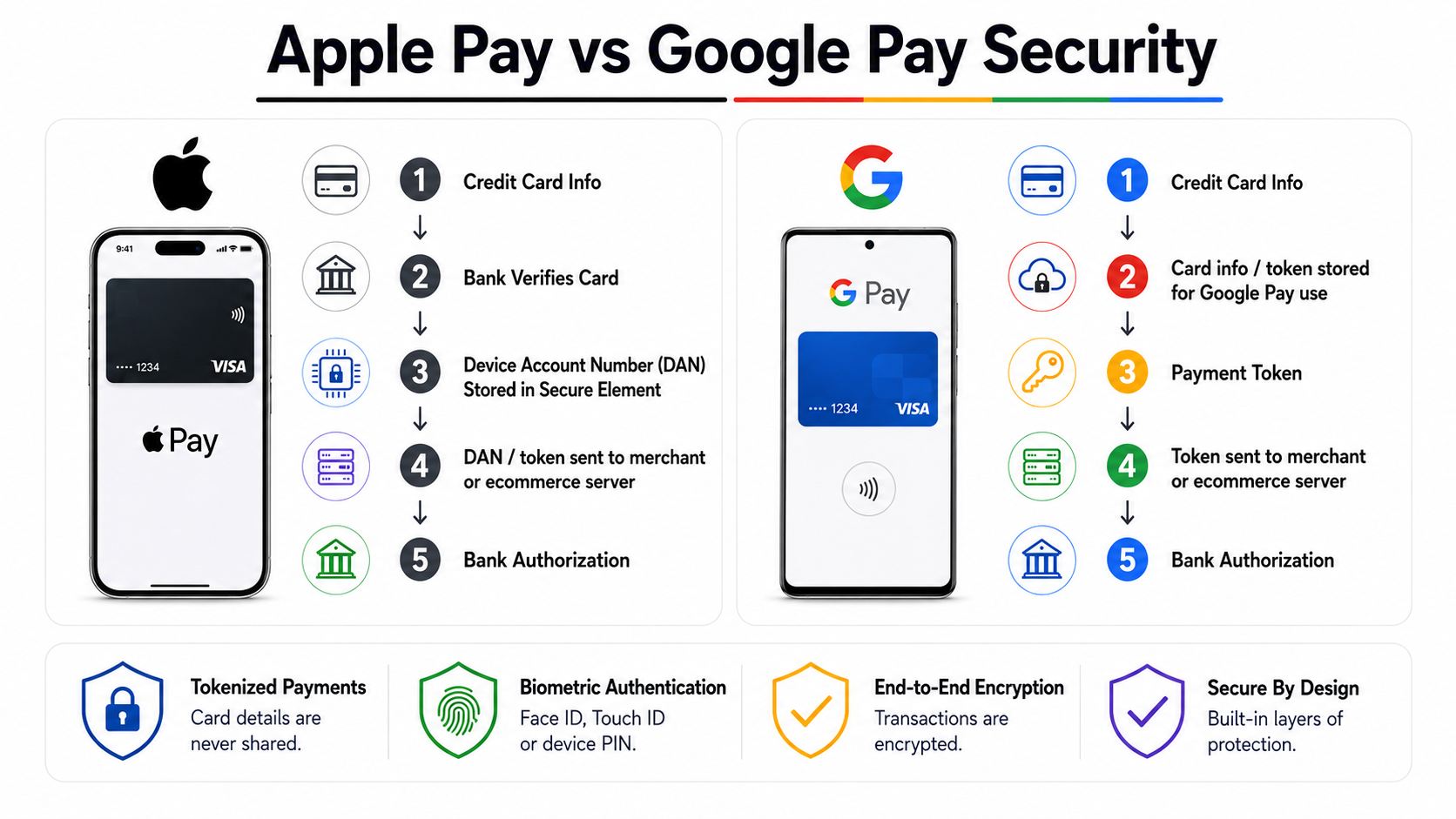
Note: The diagram is simplified and should not be treated as a complete technical architecture of Apple Pay or Google Pay. It is used here as a conversation starter about tokenization, trust anchors, and Zero Trust design.
Digital wallets are usually discussed from a consumer convenience perspective.
Tap your phone.
Authenticate with Face ID, Touch ID, fingerprint, PIN, or passcode.
Payment approved.
Simple. But for security architects, Apple Pay and Google Pay are more interesting than that.
They are practical examples of how modern systems reduce risk by moving away from static secrets and toward tokenized, contextual, and device-aware trust. That is also where identity security and Zero Trust architecture have been moving.
The diagram is useful, but not complete
There is a popular diagram comparing Google Pay and Apple Pay. It presents Google Pay as a cloud-centric model and Apple Pay as a device-centric model. As a conversation starter, that is useful. As a full technical architecture, it is too simple.
The main correction is straightforward: both Apple Pay and Google Pay use tokenization in their contactless wallet model. In a normal in-store wallet payment flow, the real card number should not be exposed to the merchant transaction path.
Apple states that Apple Pay uses a Device Account Number and keeps payment credentials in the Secure Element, isolated from iOS. Apple also states that the card number used for purchases is not stored on Apple servers.
Google explains that Google Wallet uses device tokens and virtual account numbers in place of the real card number for wallet payment flows, and issuer-facing documentation describes this in DPAN terms.
So the lesson is not "Apple Pay secure, Google Pay insecure." The better lesson is this: both systems reduce risk by replacing sensitive payment data with scoped tokens, while showing different trust-anchor and platform design choices.
The real security lesson: stop exposing the original secret
A traditional payment card is powerful because the card number is reusable. That is also what makes it risky. If that static identifier is stolen and replayed, the blast radius can be large until the issuer blocks it.
Digital wallets change the model. Instead of repeatedly exposing the original card number, the payment ecosystem uses a tokenized credential that is more limited, contextual, and often device-bound.
This pattern is exactly what strong identity design aims for:
- The original secret is exposed less often.
- The replacement credential has a narrower scope.
- Transactions include extra validation signals.
- If interception happens, the attacker gets less reusable value.
In identity terms, a reusable password looks like the old card number. It is static, phishable, reusable, and often trusted too broadly for too long. Modern identity security shifts away from that model using short-lived tokens, phishing-resistant authentication, device compliance, risk signals, Conditional Access, and continuous validation.
Do not trust a secret only because it exists. Validate context every time.
Where should trust live?
The interesting architecture question is not whether Apple Pay or Google Pay "wins." The better question is: where should trust live?
On device hardware? In cloud controls? With the issuer? In payment network policies? In merchant-side controls? In all of them?
Apple Pay is often described as more device-centric because key payment material is tied to Secure Element behavior on Apple hardware. Google Wallet also uses device tokens and virtual account numbers while integrating tightly with account and cloud service layers for online and merchant scenarios.
Modern security does not depend on one control plane. Not only device. Not only cloud. Not only identity provider. Not only issuer. Not only application. Strong design spreads trust across independent controls and validates in context. That is Zero Trust thinking in practice.
The Microsoft security analogy
For Microsoft security architects, this payment comparison maps well to identity and endpoint trust patterns.
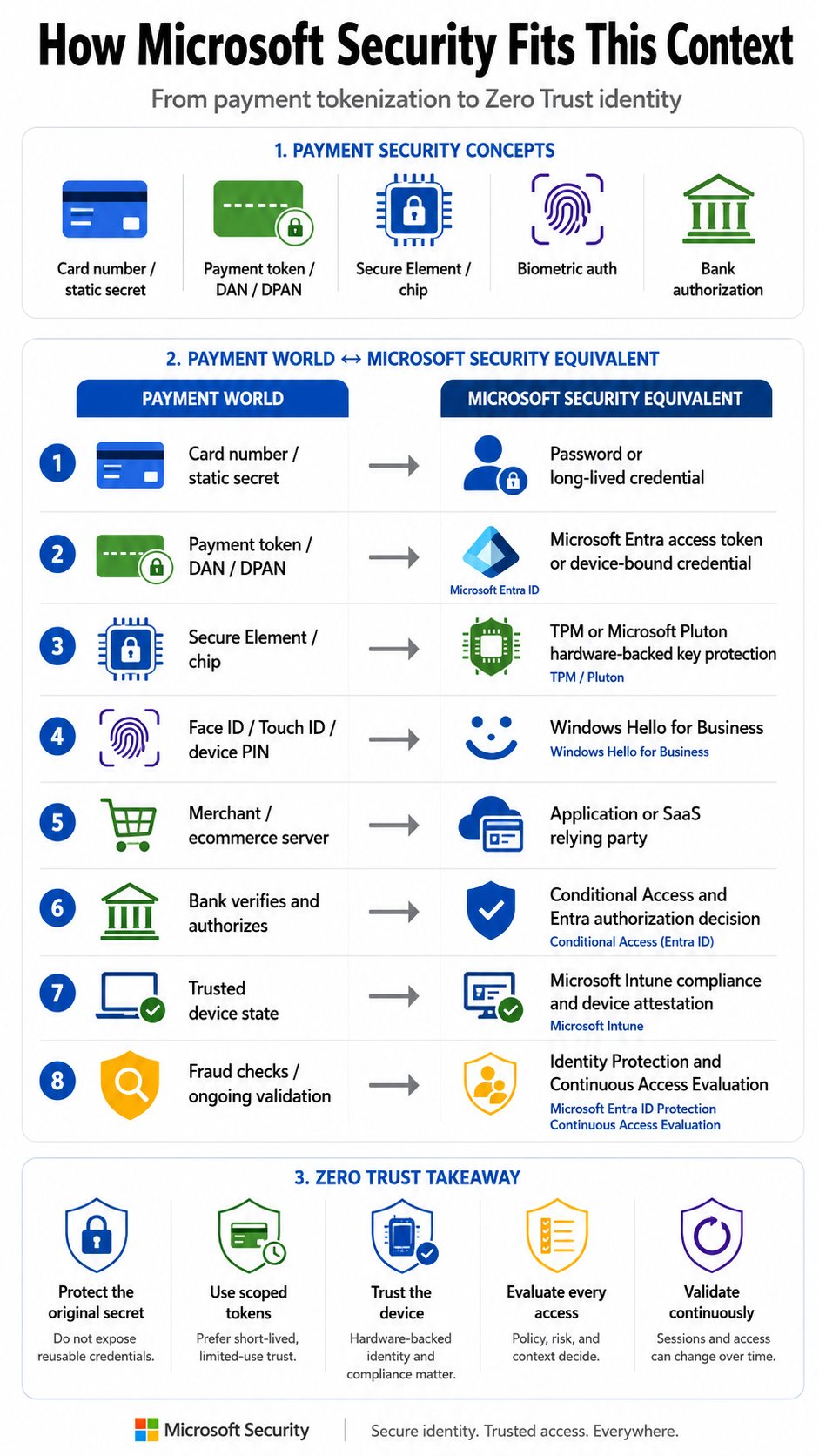
| Payment security concept | Microsoft security analogy |
|---|---|
| Real card number | Password or long-lived shared secret |
| Device Account Number / DPAN / virtual account number | Scoped token or device-bound credential |
| Secure Element and hardware-backed wallet protections | TPM, Microsoft Pluton, and hardware-backed key protection |
| Wallet unlock (biometric or PIN) | Windows Hello for Business and phishing-resistant auth |
| Payment authorization | Conditional Access decision and policy enforcement |
| Fraud and transaction-risk checks over time | Identity Protection signals and Continuous Access Evaluation |
| Merchant does not receive the real card number in a tokenized wallet transaction | Application should not collect or store the user's primary credential |
The comparison is not one-to-one. A payment token is not the same as a Microsoft Entra access token, and a bank authorization path is not identical to Conditional Access logic. Still, the architecture pattern lines up well:
Protect the original secret. Issue scoped credentials. Bind trust to device and context. Validate before allowing transaction. Limit blast radius if compromise happens.
What Zero Trust architects can learn from digital wallets
Digital wallets highlight several Zero Trust principles clearly.
- Do not expose high-value secrets unless absolutely required.
- Scope trust tightly; tokens should not work everywhere for everything.
- Treat device trust as part of the authorization decision.
- Authentication is necessary but not sufficient; transaction validation still matters.
- Assume one layer can fail, then design to contain impact.
That maps directly to identity security operations. A successful sign-in should not grant unlimited access. A compliant device state can change. A token that was safe at 09:00 can become risky at 09:15. That is why Conditional Access, Intune compliance, Identity Protection, session controls, phishing-resistant methods, and Continuous Access Evaluation are central controls.
From payment tokenization to identity tokenization
The strongest lesson from Apple Pay and Google Pay is not about payment apps. It is about security architecture evolution.
Old model: present the same static secret repeatedly and hope it does not leak.
Modern model: replace static secrets with scoped tokens, bind trust to context, and validate continuously.
For identity programs, that means:
- Move away from passwords as the primary trust anchor.
- Reduce long-lived static credentials.
- Prevent applications from collecting unnecessary secrets.
- Scope tokens and enforce least privilege.
- Make access conditional on current context.
- Evaluate device state continuously.
- Monitor risk and revoke quickly when risk changes.
The closer your architecture gets to this model, the smaller your breach blast radius becomes.
Final thought
Apple Pay and Google Pay are not only payment tools. They are practical examples of modern trust design. They show why static secrets are risky, why tokenization matters, why hardware-backed controls help, and why every transaction needs context-aware validation.
For security architects, the most important question is not "Is Apple Pay better than Google Pay?" It is this:
Are we still building identity systems like old card payments, where the same reusable secret is trusted everywhere?
Or are we building them like modern wallets: tokenized, scoped, device-aware, and continuously validated?
Source links
- Apple Support: Security and privacy overview for Apple Pay
- Google Blog: Device tokens in Google Wallet
- Microsoft Learn: Conditional Access overview
- Microsoft Learn: Continuous Access Evaluation
- Microsoft Learn: Authentication strengths
- Microsoft Learn: What is Microsoft Intune
- Microsoft Learn: Microsoft Entra ID Protection overview
- Microsoft Learn: Windows Hello for Business
- Microsoft Learn: Microsoft Pluton security processor
- Microsoft Learn: Trusted Platform Module overview