


Why this announcement matters
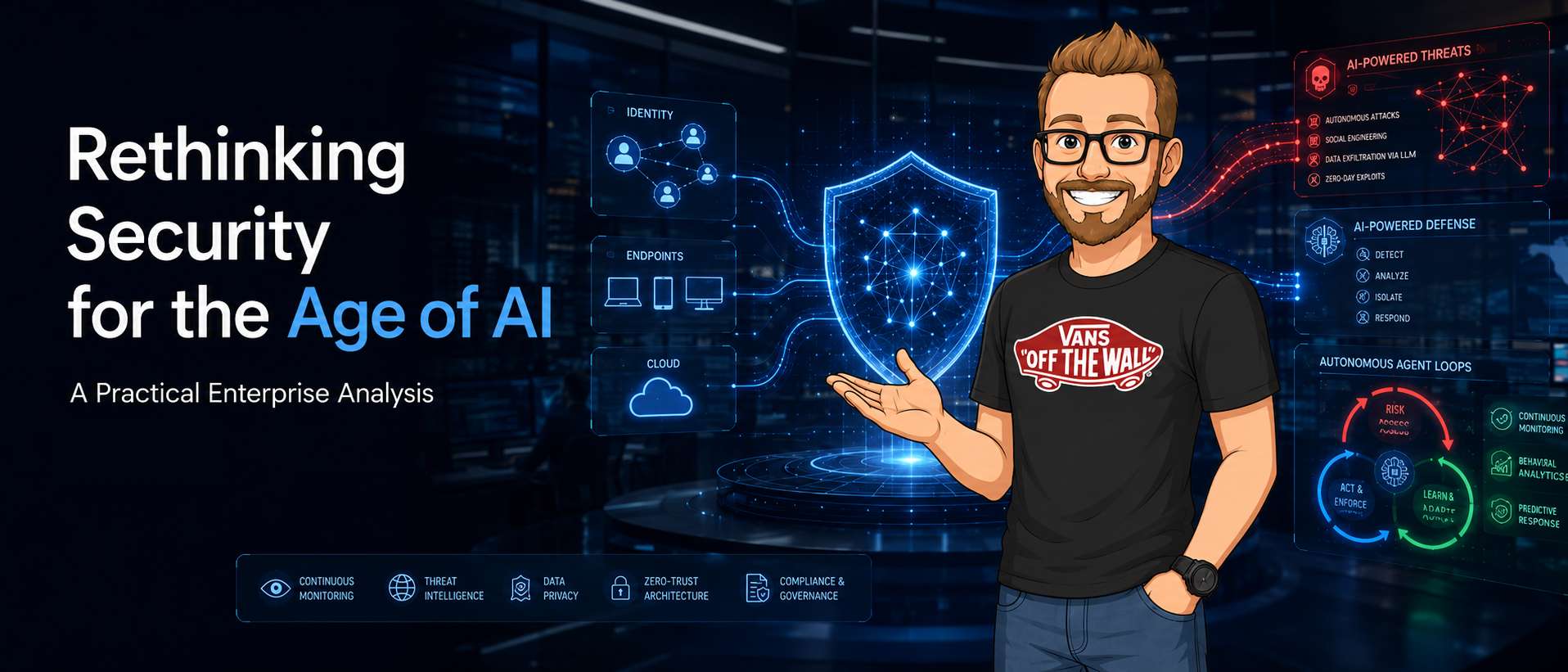
Microsoft's post, Rethinking security for the age of AI, is not just a launch note. It is a shift in operating model. The core argument is that cyber offense is now machine-speed, so defense has to move from periodic analysis to continuous adaptive control.
I agree with the direction. Most enterprise SOC stacks were built for a world where analysts triage queues and engineers patch over days or weeks. In agentic systems, that timeline is too slow. If a malicious instruction can trigger a tool call in seconds, your detection and response path cannot be measured in ticket cycles.
What is actually new here
There are three things in this announcement that matter more than the branding:
- Closed-loop security operations: red, blue, and green agents form a continuous cycle instead of isolated teams and tools.
- Context as an execution primitive: not just telemetry collection, but a shared operational context layer that agents can reason over directly.
- Model-routing economics: model selection is treated as an operational constraint, not just an R&D choice.
That third point is easy to miss. The related MAI-Cyber-1-Flash announcement describes a hybrid pattern where compact models handle high-volume tasks and larger models are reserved for hard cases. That pattern matters because security coverage at scale fails if per-event inference cost is uncontrolled.
Key point: Security in AI systems now has two equally hard constraints: detection quality and token economics. If either fails, the control plane becomes unstable.
Threat economics: what changes in real environments
Enterprise teams should frame this as an economics problem first, then an architecture problem. Attackers can now generate exploit hypotheses, social engineering variants, and probing traffic at lower unit cost. Defenders must absorb this higher pressure without multiplying headcount linearly.
That changes the control objective:
- Old objective: find high-severity events quickly enough.
- New objective: maintain bounded risk under high-volume adversarial pressure with deterministic controls and budget limits.
In practical terms, this means:
- high-confidence automation for repetitive low-risk tasks,
- policy-guarded automation for medium-risk actions,
- mandatory human approval for irreversible or high-impact actions.
Cyber Stack deconstructed: layer by layer failure analysis
| Layer | What success looks like | Failure mode | Control and evidence |
|---|---|---|---|
| Signals and sensors | Coverage across identity, endpoint, cloud, data, apps, and AI interactions | Blind spots create false negatives and misleading confidence | Coverage SLOs, connector health checks, source integrity validation |
| Context | Fresh entity relationships, ownership, attack paths, and policy mappings | Stale context drives wrong triage and unsafe actions | Context freshness budgets, graph reconciliation jobs, owner completeness metrics |
| Models | Task-fit routing with measured quality, latency, and cost | Expensive routing or poor reasoning under load | Per-task model policy, evaluation benchmarks, token budget guardrails |
| Harness | Deterministic orchestration, tool permissions, and policy gates | Agent can call tools outside expected boundaries | Signed tool catalogs, allow-lists, step-level authorization logs |
| Agents | Narrow mission agents with isolated privileges and lifecycle controls | Privilege overlap and agent sprawl | Unique identity per agent, sponsor/owner enforcement, entitlement reviews |
| Actuators | Fast, reversible, auditable actions in downstream systems | Runaway automation, accidental outages, data leakage | Risk-tiered approvals, canary execution, rollback playbooks, action signing |
The assumptions you should challenge before adoption
- "More telemetry automatically means better reasoning"
It does not. Uncurated data increases token spend and can reduce signal quality. Your context layer needs strict schemas and data contracts. - "One strong model can do everything"
Security workflows are not uniform. Triage, vulnerability analysis, policy explanation, and incident summarization are different tasks with different failure costs. - "Automation reduces operational risk by default"
Automation moves risk. It helps when controls are explicit. It harms when action boundaries are weak. - "Identity can be solved later"
It cannot. If identity and ownership are unclear at launch, every later governance control is weaker.
Identity and control plane: the non-negotiable baseline
Project Perception describes how a defense system behaves. Microsoft Entra Agent ID defines who acts, under what policy, and with what accountability trail. These are inseparable.
Identity baseline
- one identity per agent role or instance, no shared technical identities;
- owner and sponsor for every privileged agent identity;
- separation of runtime identities from CI/CD deployment identities;
- workload identity federation for pipelines and external runtimes;
- time-bound privilege elevation with explicit expiry and review.
Token-level observability requirements
For high-assurance environments, logs should retain enough identity claims to reconstruct delegated action chains and policy decisions. If you cannot answer "which agent called which tool with which effective permissions," your post-incident analysis will be incomplete.
Microsoft security feature stack: what is actually doing the work
Most architecture write-ups stay abstract. The practical question is simpler: which Microsoft security features actually enforce the boundaries when agents run in production. This stack is where Project Perception becomes implementable.
1) Foundry Control Plane as the governance surface
Foundry Control Plane gives you centralized inventory, policy application, compliance views, and operational monitoring across agents, models, and tools. It is where governance shifts from slide decks to runtime controls.
- use it to track agent health, token usage, and cost trends in one place;
- apply guardrail and compliance policies at fleet level instead of per-project drift;
- link runtime issues back to evaluation and monitoring views for root-cause analysis.
If this layer is weak, your fleet fragments into independent islands with inconsistent policy, inconsistent telemetry, and inconsistent incident evidence.
2) AI gateway in API Management for front-door enforcement
The AI gateway pattern in API Management is your policy choke point for model and tool traffic. It enforces quotas, throttling, and standardized control policies before requests hit model backends.
- rate limits and token quotas prevent unbounded consumption attacks;
- central policy layer keeps multi-team model use consistent;
- agent and tool registration creates a governed inventory across environments.
Without a gateway layer, every team implements policy slightly differently, which creates uneven control quality and hidden cost risk.
3) Defender for Cloud AI threat protection for runtime detection
Defender for Cloud AI threat protection is your runtime detection plane for AI-specific abuse patterns. It is built to surface prompt injection attempts, data leakage risk, credential theft indicators, and suspicious behavior patterns tied to AI workloads.
- use AI security recommendations to catch design-time misconfigurations;
- enable suspicious prompt evidence to improve triage quality during active incidents;
- connect alerts into Defender XDR for cross-domain investigation and response.
This is critical because classic cloud detections alone do not describe model-level attack paths well enough.
4) Content Safety prompt shields as model-input and output defenses
Azure AI Content Safety prompt shields add a dedicated control layer for prompt-level manipulation and jailbreak-like behavior. In practice, this is one of the strongest controls against indirect instruction attacks in mixed-data workflows.
- screen inbound content before it reaches high-privilege tool paths;
- treat shield outcomes as enforceable policy signals, not just advisory flags;
- combine with output validation so unsafe generation does not trigger downstream actions.
5) Entra Agent ID and workload identity federation for identity trust
Microsoft Entra Agent ID gives identity structure to agentic workloads. Workload identity federation removes long-lived secrets from CI/CD and external runtime integration paths. Together, they reduce identity ambiguity and secret sprawl.
- identity per agent role or instance, with accountable owners;
- federated identity for pipelines and cross-cloud execution paths;
- clean audit chain for delegated tool actions and policy decisions.
If identity is not engineered first, every downstream security control has weak attribution and weaker incident recovery.
6) Sentinel and Defender XDR for SOC correlation and action
Detection only matters when it can be correlated, triaged, and acted on quickly. Microsoft Sentinel provides SIEM depth and flexible detection workflows. Defender XDR provides cross-domain incident stitching across endpoints, identities, email, and cloud.
- Sentinel normalizes and correlates operational and security signals;
- XDR correlation reduces blind spots between AI events and classic attack telemetry;
- SOC playbooks can route low-risk actions to automation and escalate high-impact actions to humans.
7) Channel and endpoint guards for prompt injection entry points
Prompt injection enters through channels, files, web content, and tool responses. Microsoft has started to put explicit controls at those boundaries:
- Defender for Office 365 prompt injection detection for inbound email threats;
- Defender for Endpoint AI agent runtime protection (preview) for local agent execution paths;
- Defender telemetry feeds back into incident correlation for faster containment.
This is important because many agent incidents start outside your model runtime, then propagate inward through trusted ingestion paths.
Feature-to-kill-chain mapping
| Attack phase | Primary Microsoft control | What evidence you should get |
|---|---|---|
| Initial malicious prompt delivery | Defender for Office 365 prompt injection detection | message-level detection verdicts and security events |
| Prompt and context manipulation | Content Safety prompt shields + Defender for Cloud AI monitoring | prompt risk signals and correlated runtime alerts |
| Unauthorized tool invocation attempt | AI gateway policy + Entra identity scoping | blocked call logs with principal identity and policy reason |
| Lateral movement through integrated systems | Sentinel + Defender XDR correlation | cross-domain incident graph and timeline evidence |
| High-impact action execution | Actuator approval workflow + SOC runbooks | approval trails, action logs, rollback evidence |
Design rule: no single Microsoft product solves agentic risk by itself. The reduction in risk comes from how these features are chained, where policy decisions are enforced, and how evidence is preserved for SOC action.
Teams, DevOps, and SOC: where this architecture succeeds or fails
The architecture becomes real in daily workflows, not in diagrams. There are three stress points to engineer carefully.
Stress point 1: human interaction channels
Teams, email, and chat channels are now attack delivery paths for model-level manipulation. Defender guidance on prompt injection in communication channels makes this explicit. Treat every external message as a possible instruction payload, not just as content.
Stress point 2: tooling boundaries
Most severe incidents happen when an agent can call a powerful tool without enough contextual checks. OWASP LLM06 (Excessive Agency) and LLM05 (Improper Output Handling) are directly relevant here.
Stress point 3: SOC operating model
Analysts need behavior-level visibility and predictable override controls. Microsoft Sentinel and Defender integration help, but process design is still your responsibility.
| SOC tier | What agents should do | What humans must still own |
|---|---|---|
| L1 | Triage, enrichment, clustering, duplicate suppression | Final alert disposition for ambiguous cases |
| L2 | Hypothesis generation, attack path expansion, recommended containment | Containment approval when blast radius is uncertain |
| L3 | Patch candidate generation, control tuning suggestions, regression checks | Production change approval and emergency rollback governance |
Framework crosswalk: OWASP, NIST, and enterprise controls
To keep this implementation grounded, map the architecture to public frameworks.
OWASP LLM Top 10 mapping
- LLM01 Prompt Injection: require input isolation, prompt shields, and tool-call policy gates.
- LLM05 Improper Output Handling: validate model outputs before downstream execution.
- LLM06 Excessive Agency: scope every tool invocation by least privilege and context.
- LLM08 Vector and Embedding Weaknesses: enforce integrity checks for retrieval pipelines.
- LLM10 Unbounded Consumption: set token quotas, rate limits, and cost alerts by agent.
NIST AI RMF mapping
- Govern: define ownership, escalation authority, and acceptable autonomy levels.
- Map: classify agents by mission, data sensitivity, and actuator scope.
- Measure: continuously evaluate accuracy, safety, latency, and cost.
- Manage: enforce release gates, incident drills, and control updates.
What to measure if you want this to work
Most teams measure volume. Better teams measure control quality. The minimum KPI set I recommend:
- mean time from risky prompt detection to containment action;
- false action rate for autonomous or semi-autonomous remediations;
- agent identity hygiene: orphaned agents, missing sponsors, overdue access reviews;
- tool-call policy violation rate per agent role;
- cost per contained incident and token spend per successful remediation;
- prompt injection catch rate by channel (email, chat, tool response, file ingestion).
Operational rule: if you cannot explain why an automated action happened in less than five minutes using logs and policy evidence, your system is not production ready for high-impact autonomy.
Deeper implementation roadmap (180 days)
Phase 1 (Days 0-30): establish hard boundaries
- Build full agent inventory with owner, sponsor, platform, and permissions.
- Move all CI/CD identities to workload identity federation.
- Classify actuators into low, medium, and high-risk categories.
- Define high-impact action approval policy with fallback and rollback.
Phase 2 (Days 31-60): harden and test
- Run adversarial testing for direct and indirect prompt injection paths.
- Turn on prompt evidence and AI threat protection controls where available.
- Attach every production agent workflow to SIEM correlation and case workflows.
- Require output validation before tool execution.
Phase 3 (Days 61-120): automate with policy depth
- Enable bounded auto-remediation for repetitive low-risk actions.
- Deploy model-routing policy based on quality and budget constraints.
- Add drift detection for context freshness and policy violations.
- Track per-agent cost, efficacy, and incident outcomes monthly.
Phase 4 (Days 121-180): institutionalize governance
- Run quarterly tabletop incidents focused on autonomous failure modes.
- Audit data residency, retention, and deletion controls for memory stores and logs.
- Formalize architecture review board for new agent classes and actuator expansions.
- Publish an internal transparency note for business stakeholders on agent decision boundaries.
Hard questions for leadership teams
- Which agent actions are currently irreversible, and who can stop them?
- Do we have one accountable owner per production agent identity?
- Can we prove least privilege on every tool integration this quarter?
- Are we testing against OWASP LLM risks before every major release?
- Do we have budget alarms tied to security model routing and token use?
- Do our board-level risk reports include agentic control failures, not only breaches?
Final view
This announcement is directionally strong. It recognizes that AI security is now a systems problem: identity, context, models, orchestration, and action have to work together under pressure.
The winning strategy is not maximal autonomy. It is controlled autonomy: identity-first governance, measurable policy boundaries, and selective automation where evidence shows reliability. If you implement that sequence, agentic security can lower risk. If you skip that sequence, it can increase blast radius faster than traditional tooling ever could.
Sources and further reading
- Rethinking security for the age of AI (Microsoft Blog, July 2026)
- Introducing MAI-Cyber-1-Flash inside MDASH (Microsoft AI, July 2026)
- Govern and secure AI agents across the organization (Microsoft Cloud Adoption Framework)
- What is Microsoft Foundry Control Plane?
- Monitor agent health and performance across your fleet (Foundry Control Plane)
- AI gateway capabilities in Azure API Management
- AI threat protection in Microsoft Defender for Cloud
- Enable threat protection for AI services (Defender for Cloud)
- AI security recommendations in Defender for Cloud
- Prompt injection protection in Microsoft Defender for Office 365
- AI agent runtime protection with Microsoft Defender for Endpoint (Preview)
- What is Microsoft Sentinel?
- What is Microsoft Entra Agent ID?
- Authentication protocols in agents
- Workload identity federation concepts
- Azure AI Content Safety jailbreak and prompt shield detection concepts
- Responsible AI for Microsoft Foundry
- OWASP Top 10 for LLM and GenAI Applications (2025)
- NIST AI Risk Management Framework